


Why Industrial AI Pilots Stall at the Factory Gate, and the ERP Data Fix That Unblocks Them
Industrial AI can predict equipment failures, detect quality defects, and optimize production schedules. Yet, despite promising pilot results, many manufacturers struggle to extend these capabilities beyond a single production line or facility.
Consider a predictive maintenance pilot that successfully identifies early signs of machine failure. Engineers validate its predictions, downtime risks become more visible, and the business case looks convincing.
Then the manufacturer attempts to deploy the same solution across multiple plants.
Equipment identifiers differ, maintenance records sit in separate applications, and production schedules aren’t consistently synchronized. Suddenly, the model that performed well during testing struggles to deliver reliable recommendations.
The challenge isn’t always the AI model. More often, it’s the fragmented operational data surrounding it.
This is where Enterprise Resource Planning (ERP) data integration becomes essential. By connecting business information with shop-floor intelligence, manufacturers can move beyond isolated AI experiments and build scalable, dependable industrial AI applications.
Why Industrial AI Pilots Fail to Scale in Manufacturing
Industrial AI pilots frequently succeed because they operate within carefully controlled conditions.
Data is collected from selected equipment, historical records are cleaned, and engineers manually resolve inconsistencies before models are trained. These activities help demonstrate technical feasibility but rarely represent everyday manufacturing conditions.
Once deployment expands, AI applications must process information from different machines, facilities, software platforms, and operational workflows.
A model trained on one production line may encounter unfamiliar operating conditions elsewhere. Missing maintenance records, inconsistent timestamps, and different equipment configurations can further reduce its reliability.
The National Institute of Standards and Technology (NIST), in its 2026 Roadmap on Artificial Intelligence and Machine Learning for Smart Manufacturing, identifies industrial data complexity, heterogeneous system integration, and trustworthy AI operation as significant manufacturing challenges.
The distinction is important: developing an accurate AI model and deploying a reliable manufacturing AI system are two different achievements.
Successful scaling requires more than predictive accuracy. It demands consistent data availability, operational integration, monitoring, and the ability to turn predictions into decisions.
The Hidden Data Challenges Behind Industrial AI Pilot Failures
Manufacturing environments produce vast quantities of data, but that information is rarely available in a unified, usable format.
ERP platforms manage procurement, inventory, financial transactions, and production orders. Manufacturing Execution Systems (MES) record production activities, while Industrial Internet of Things (IIoT) platforms collect machine-level information.
When these systems operate independently, AI receives only fragments of the complete manufacturing picture.
Inconsistent Manufacturing Master Data
Equipment, materials, and production orders may have different identifiers across systems.
For example, a machine recorded as MCH-102 in an IIoT platform might appear under another asset code in ERP.
Without consistent mapping, AI cannot reliably associate equipment behavior with corresponding maintenance, inventory, or production records.
Missing Production and Equipment Context
Sensor readings alone rarely explain why operational changes occur.
An unexpected temperature increase might indicate equipment deterioration, but it could also result from a planned production adjustment.
Without production orders, operating parameters, and historical maintenance context, AI may generate misleading alerts.
Delayed Data Exchange Across Factory Systems
Industrial sensors can generate readings continuously, while ERP transactions may update at different intervals.
When operational and business information isn’t synchronized, AI recommendations may rely on outdated schedules or inventory records.
These inconsistencies become particularly difficult to manage across multiple manufacturing facilities.
How ERP Data Integration Helps Industrial AI Scale
Industrial AI becomes more valuable when machine intelligence is connected with enterprise business information.
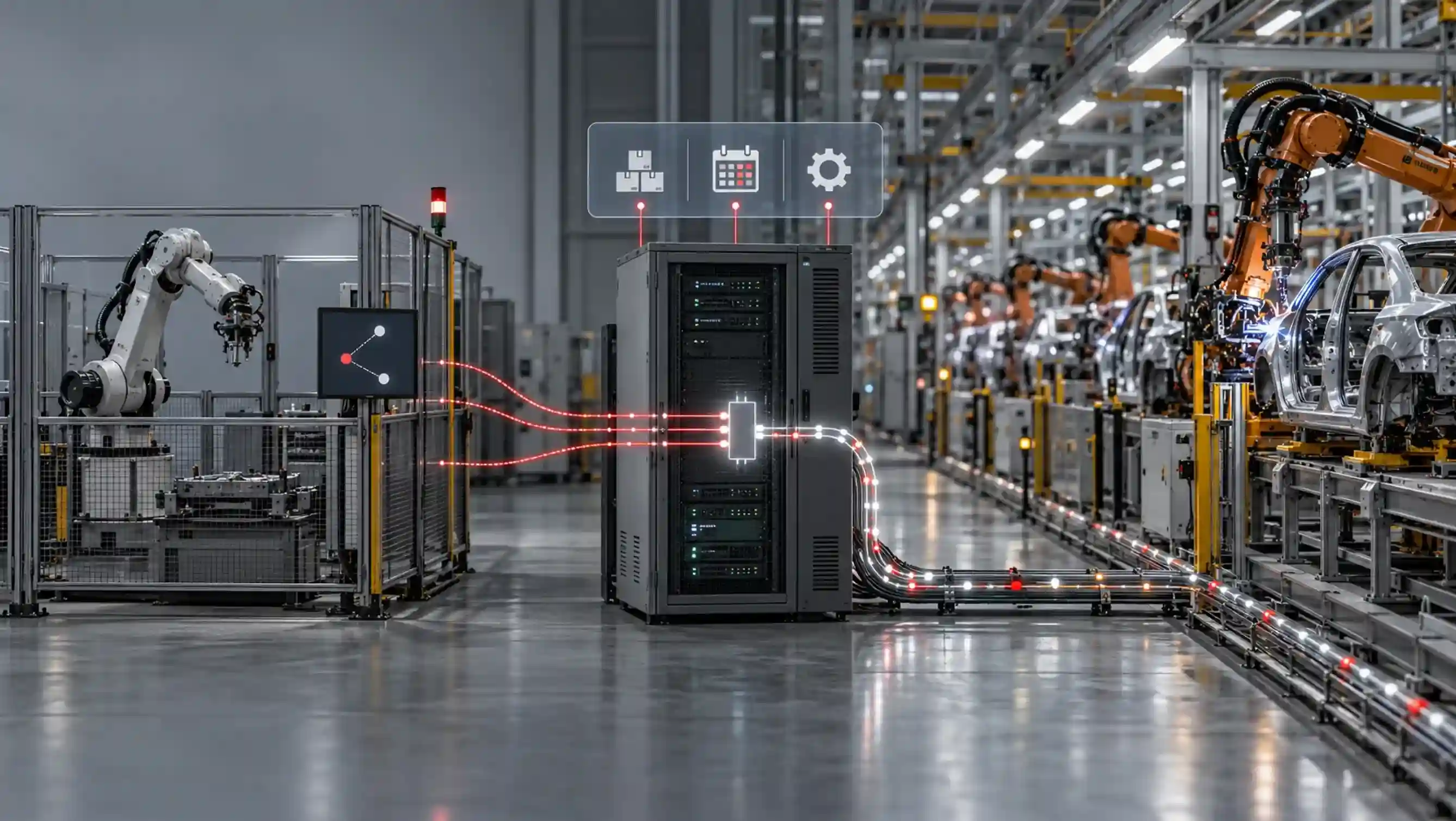
An IIoT platform can identify unusual equipment behavior. ERP provides the context needed to understand its potential impact on production, maintenance, inventory, and customer commitments.
Consider an AI model predicting that a critical machine may fail within the next 48 hours.
Without ERP integration, maintenance teams receive an alert.
With connected ERP information, the system can also identify replacement-part availability, upcoming production commitments, maintenance requirements, and possible scheduling conflicts.
The prediction becomes part of a coordinated operational decision rather than an isolated technical warning.
This doesn’t require replacing every existing application. Manufacturers can improve their data foundations through targeted ERP integration and modernization, connecting operational systems with the enterprise records that influence manufacturing decisions.
The objective is straightforward: make business and manufacturing information consistent, accessible, and usable across AI applications.
5 ERP Data Fixes for Scaling Industrial AI in Manufacturing
Building a scalable industrial AI environment requires a structured approach to data quality, system connectivity, and operational execution.
1. Standardize Master Data Across Manufacturing Systems
Manufacturers should establish consistent identifiers for equipment, materials, production orders, suppliers, and facilities.
Standardized master data allows AI to connect information from multiple systems without repeated manual reconciliation.
Clear ownership is equally important. Maintenance, operations, and IT teams must establish which applications maintain authoritative records and how updates are shared.
This creates a reusable data foundation when AI expands to additional machines or facilities.
2. Integrate ERP, MES, and IIoT Data
ERP, MES, and IIoT platforms serve different purposes, but industrial AI benefits from their combined information.
Connecting these systems enables manufacturers to relate equipment performance to production schedules, material consumption, and quality outcomes.
Not every sensor reading needs to enter ERP. High-frequency machine data can remain within industrial platforms, while relevant events are connected to enterprise transactions.
APIs, event-driven integration, and standardized data models help establish these connections without unnecessarily increasing system complexity.
3. Improve Manufacturing Data Quality
Industrial AI predictions depend on trustworthy historical and operational information.
Incomplete maintenance histories, duplicate asset records, incorrect timestamps, and inconsistent measurement units can weaken model performance.
Automated validation, data reconciliation, and continuous quality monitoring help identify these issues before they affect production decisions.
Manufacturers should also monitor whether data quality deteriorates as equipment configurations, processes, and operating conditions change.
4. Build a Governed Industrial Data Architecture
Connecting every AI application directly to individual manufacturing systems creates integration complexity.
A governed data architecture provides common definitions and controlled access to ERP transactions, MES events, equipment measurements, and maintenance information.
This approach supports reusable datasets, security controls, traceability, and consistent data interpretation.
It also reduces the effort required to introduce additional AI applications without rebuilding the same integrations.
5. Connect AI Insights to Manufacturing Workflows
An accurate prediction delivers limited value unless someone can act on it.
Maintenance recommendations should support work-order planning. Quality alerts should connect with inspection processes. Production forecasts should influence scheduling and material decisions.
AI outputs can initiate recommendations or approval workflows while operational teams retain appropriate decision-making control.
This helps industrial AI become part of everyday manufacturing operations rather than another disconnected analytics dashboard.
Business Benefits of ERP-Integrated Industrial AI
Reliable ERP data integration expands the practical value of industrial AI across manufacturing functions.
Predictive maintenance: Equipment health predictions can be evaluated alongside maintenance schedules, spare-parts availability, and production commitments.
Quality management: Defect patterns can be associated with material batches, equipment conditions, and production orders, supporting more targeted investigations.
Production optimization: Scheduling recommendations can account for equipment availability, inventory constraints, and order priorities.
Inventory planning: Consumption forecasts can be connected with procurement lead times, demand changes, and manufacturing capacity.
These applications demonstrate why manufacturers need more than accurate predictive models. They need AI systems that understand the operational consequences of their recommendations.
Actual improvements depend on data reliability, system integration, process adoption, and continuous performance measurement.
How to Move Industrial AI From Pilot to Production
Scaling industrial AI doesn’t necessarily require a complete ERP replacement or factory-wide technology overhaul.
A more practical approach starts with one high-value use case and the minimum information needed to support it reliably.
For predictive maintenance, this might include equipment identifiers, maintenance transactions, sensor histories, and production schedules.
Manufacturers can identify missing connections, establish repeatable integration methods, and test the solution across additional production environments.
Performance should be evaluated using operational metrics, including unplanned downtime, maintenance efficiency, defect rates, and production reliability, rather than model accuracy alone.
NeoSOFT’s manufacturing technology solutions support connected manufacturing environments through enterprise integration, automation, IIoT, and intelligent operational systems.
The priority is to build a reliable foundation that can support multiple manufacturing AI applications without recreating the same data preparation challenges.
Building a Scalable Industrial AI Foundation
Industrial AI pilots often expose weaknesses that already exist within manufacturing information systems.
Disconnected equipment records, inconsistent master data, delayed transactions, and fragmented workflows become more visible when AI moves beyond controlled testing.
Improving algorithms alone cannot resolve these structural limitations.
Manufacturers need reliable connections between shop-floor information and the ERP data governing production, maintenance, inventory, and business operations.
Industrial AI creates greater value when it moves beyond identifying potential problems and helps manufacturing teams make informed operational decisions.
That transition begins with connected, trustworthy enterprise data.