


Designing for Trust: The UX Principles Behind Successful Financial Products
In financial services, the interface is the institution. Before a user reads a single line of fine print or speaks to a relationship manager, they have already formed a judgment — is this product safe, clear, and worthy of my money? That judgment is shaped entirely by experience design.
For CXOs navigating the competitive fintech landscape today, fintech UX design is no longer a downstream concern delegated to product teams. It is a strategic lever that directly influences customer acquisition, retention, regulatory standing, and brand equity.
The data confirms this: research indicates that nearly 89% of users would switch financial providers purely for a superior user experience. In an era where switching costs are lower than ever, design has become the moat.
Why Fintech UX Is a Category Apart
It would be tempting to view UX in financial services as a subset of general product design. It is not. Financial UX design operates under constraints that amplify the cost of every poor decision — regulatory compliance mandates, emotionally charged user journeys, high-stakes transactions, and dense data environments all collide in a single interface.
A poorly labeled button in a retail app causes minor frustration. The same in a payment product could result in a misdirected wire transfer, a compliance breach, or an irreversible loss of user confidence. The stakes are fundamentally different, and so must be the design philosophy.
This is the foundation of sound fintech UX design strategy: building not just for usability, but for confidence.
The Four Principles That Define Trustworthy Financial UX
Trust Through Transparency
Trust is not an aesthetic quality — it is an architectural one. It must be designed into every layer of the product. This begins with visible security signals: biometric authentication, clear encryption disclosures, and honest, plain-language explanations of why sensitive data is being collected.
Equally critical is the elimination of dark patterns. Hidden fees, ambiguous consent flows, and obscured risk disclosures are not just ethical failures — they are strategic ones. Users who feel misled do not simply churn; they become vocal detractors. Leading fintech UX best practices mandate that every fee, risk indicator, and data permission be surfaced proactively, not buried in footnotes.
Clarity Over Complexity
Financial products work with layered, often anxiety-inducing data — investment returns, loan amortization schedules, multi-currency balances. The design challenge is not to hide this complexity, but to sequence it intelligently. Progressive disclosure — presenting essential information first, with deeper detail available on demand — is the gold standard in fintech UX software design.
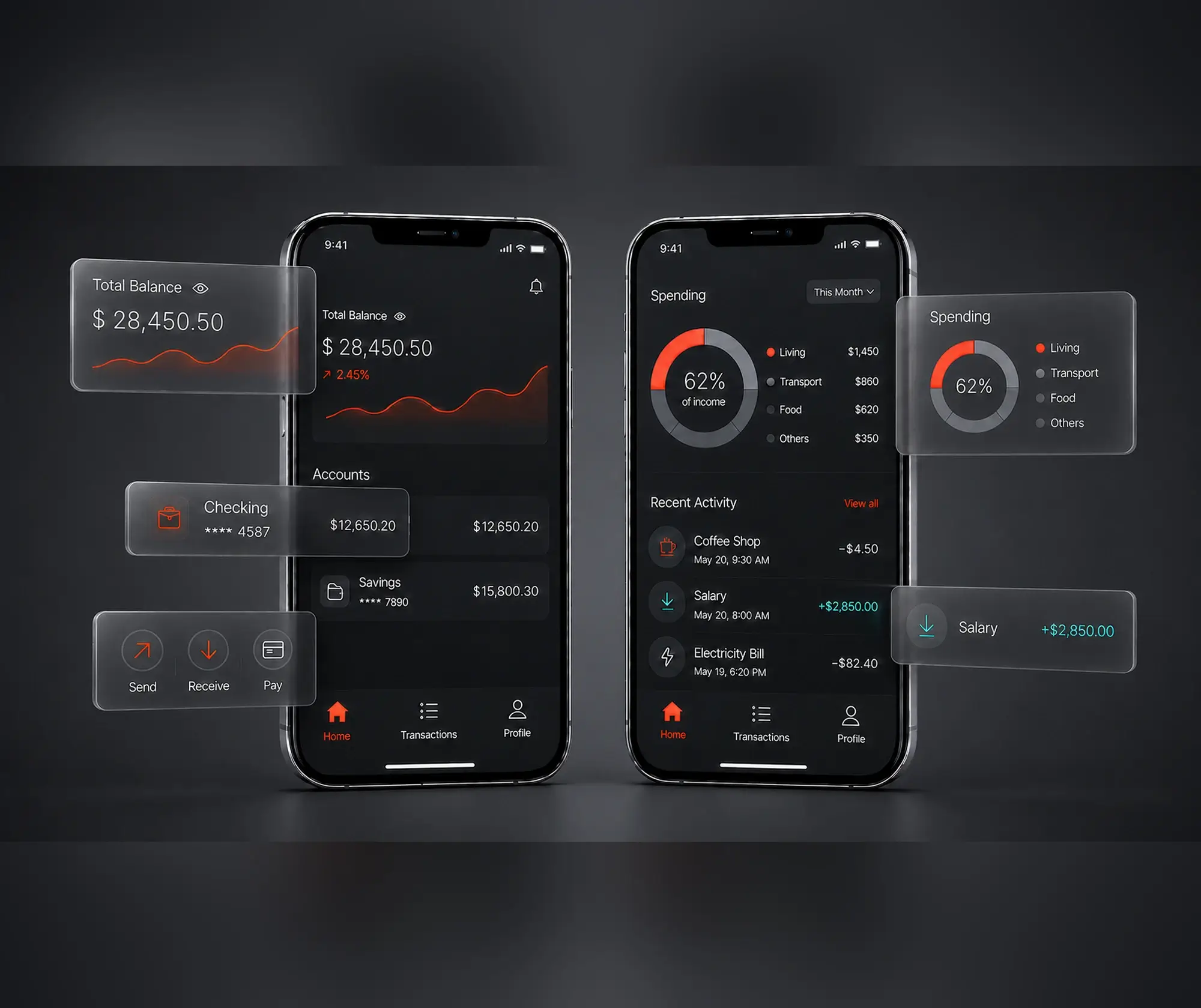
Best-in-class products like Chime demonstrate this principle by anchoring the user experience around a single, prominent number: the account balance. Everything else is organized beneath it, accessible but not intrusive. This restraint is not a limitation; it is a deliberate act of respect for the user’s cognitive and emotional bandwidth.
Empowerment Through Personalization
The most impactful shift in fintech UX trends over the past two years has been the evolution from transactional interfaces to empowerment platforms. Modern financial products now leverage behavioral data and AI to surface personalized insights — spending patterns, savings forecasts, goal progress — in ways that feel supportive rather than surveillance-oriented.
The distinction matters enormously. A nudge framed as “You’re 12% above your dining budget this month” feels helpful. One framed as “You’re overspending” feels judgmental. The language, framing, and timing of these interactions are design decisions with measurable impact on user retention and product loyalty.
Gamification elements — savings milestones, progress indicators, rewards for on-time payments — further reinforce positive financial behavior while deepening product engagement.
Continuity Across Touchpoints
CXOs overseeing multi-channel financial products understand that the user journey rarely begins and ends on a single device. A customer may initiate a loan application on mobile, review terms on desktop, and execute on a tablet. Every handoff in that journey is an opportunity for trust to either deepen or erode.
Continuity in fintech UX design means more than visual consistency across platforms. It means real-time synchronization of application states, automatic progress preservation, and clear contextual cues that orient users upon return. A unified design system — governing typography, iconography, interaction patterns, and terminology — is the operational backbone that makes continuity possible at scale.
Navigating the Strategic Challenges
Designing for trust is not without friction. Several structural challenges consistently confront organizations building or scaling financial products.
Compliance as a Design Constraint
KYC, AML, GDPR, and RBI regulations are non-negotiable, but they need not be user-hostile. Breaking mandatory disclosure flows into short, scannable steps — accompanied by plain-language explanations of why each piece of information is required — transforms compliance from a UX liability into a trust-building moment.
Integration Friction
Most enterprise financial products depend on third-party infrastructure: identity verification providers, payment rails, open banking APIs. Each integration introduces a seam in the experience. Maintaining visual and tonal continuity across these handoffs — with clear transition messaging and immediate re-orientation states upon return — is essential to preserving the sense of a coherent, trustworthy product.
Post-launch UX Governance
Among the most overlooked challenges in financial product organizations is design entropy: the gradual degradation of UX quality as new features accumulate, stakeholders rotate, and original design intent gets diluted. Establishing a living design system — with documented governance and UX metrics tied directly to business KPIs — ensures that design quality remains a sustained organizational capability, not a project-phase deliverable.
2026 Trends Reshaping Financial UX Design
Several macro trends are currently redefining what excellence looks like in fintech UX:
Conversational and voice-first interfaces are making financial management more accessible and intuitive, particularly for users who find traditional visual dashboards intimidating.
Well-designed conversational flows for balance inquiries, transfers, and alerts reduce cognitive load while broadening the product’s addressable audience.
Behavioral biometrics are supplementing traditional authentication, recognizing familiar device patterns and usage behaviors to deliver security that is both stronger and less intrusive — removing friction while increasing confidence.
Financial wellness as a differentiator. The most forward-thinking financial products in 2026 have moved beyond transaction facilitation to become active partners in financial literacy. Products that help users understand their finances — not just manage them — are building the kind of deep loyalty that no fee structure or interest rate can easily replicate.
NeoSOFT: Engineering Trust at Scale
For organizations evaluating partners capable of translating these principles into production-ready financial products, the choice of technology and design partner is consequential.
NeoSOFT brings over two decades of enterprise-grade engineering experience to the specific demands of financial UX. Unlike generalist IT services firms or narrow design studios, NeoSOFT operates at the intersection of UX strategy, compliance-aware architecture, and scalable software delivery — the precise combination that modern fintech requires.
For CXOs tasked with building financial products that earn and sustain user trust, NeoSOFT offers not just execution capacity, but a genuine partnership in design thinking.
The Strategic Imperative
The organizations winning in financial services today are not necessarily those with the most sophisticated products. They are those whose products feel the most trustworthy — because trust, ultimately, is what converts a first-time user into a long-term customer.
Designing for trust is not a UX initiative. It is a business strategy. And in 2026, it may well be the most important one on your roadmap.