

Why Vertical AI Is the Future of Enterprise Intelligence
February 17, 2026
Introduction
Artificial intelligence is a major corporate capability alongside other traditional methods. However, as more and more enterprises start using AI, generic AI is insufficient to address the real challenges of the businesses.
A business is a part of an industry, runs on complicated data, is subjected to strict compliance with regulatory requirements, and is always deeply intertwined with existing systems.
These differences result in a higher adoption of vertical AI, i.e., AI being specifically designed for a particular industry and therefore having the greatest impact on business value in the places that matter most.
From the healthcare industry to the legal industry, AI vertical strategies revolutionize the ways companies generate business value from unstructured data and automate repetitive tasks, securing a competitive advantage. This is the purpose of Vertical AI agents that are designed around deep domain expertise and real-world workflows.
This blog explores why vertical AI is the future of enterprise intelligence, how it works, and what enterprises need to know to adopt it for long-term success.
What Are Vertical AI Agents?
Vertical AI gents use domain-specific data, industry expertise, and existing workflow to perform complex tasks with high accuracy and trust.
It combines:
- LLMs or other Artificial Intelligence (AI) models
- Machine learning and other tools
- Deep domain knowledge through training data and rules
- Integration with other software and tools
- Continuous learning from interactions and feedback
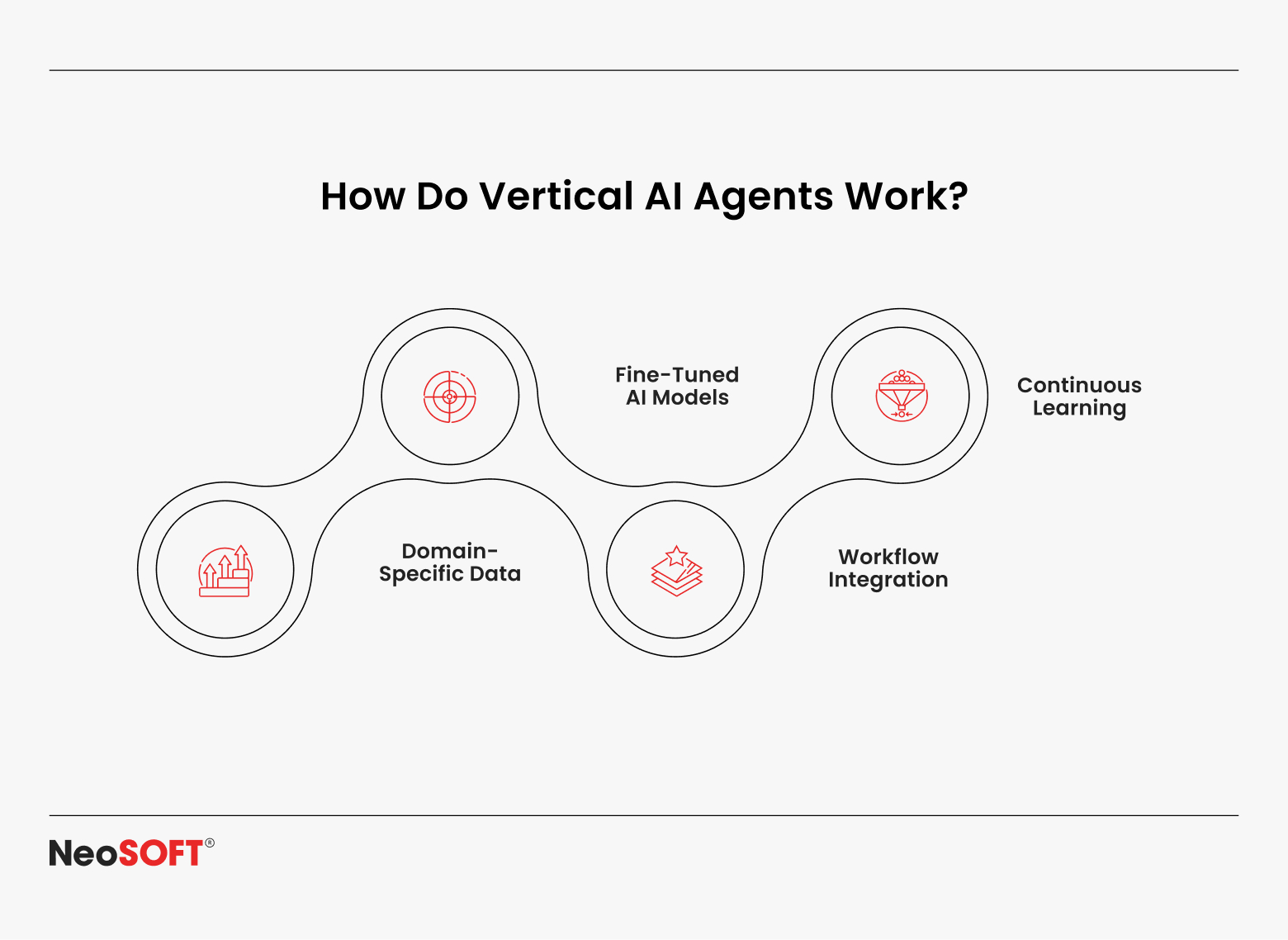
How Do Vertical AI Agents Work?
Vertical AI agents gain their success by being highly aligned with industry data, workflows, and regulations, as opposed to general-purpose AI.
1. Domain-Specific Data
Vertical AI agents that use domain-specific data for training by understanding historical records, etc., produce relevant and accurate results.
2. Fine-Tuned AI Models
They use the latest large language models for understanding complex industry jargon, regulatory requirements, and risk appetite.
3. Workflow Integration
Vertical AI is integrated with the current systems in a non-disruptive way and helps automate the most repetitive tasks, therefore, providing assistance and finding the data instantly.
4. Continuous Learning
Agents get better by using customer feedback, performance data, and new training data while continuing to be in line with changing business requirements.
Why Enterprises Are Moving to Vertical AI Agents
1. Deeper Domain Expertise
Unlike horizontal AI, vertical AI embeds industry-specific logic and regulatory knowledge.
2. Better Handling of Complex Data
Vertical AI converts unstructured data into actionable insights with higher reliability.
3. Built for Compliance
Vertical AI agents are built for regulated industries such as governance, auditability, and ethical concerns.
4. Higher ROI
Vertical AI zooms in on primary workflows and automation, almost to the point of delivering the exact business impact that generic AI tools fail to provide.
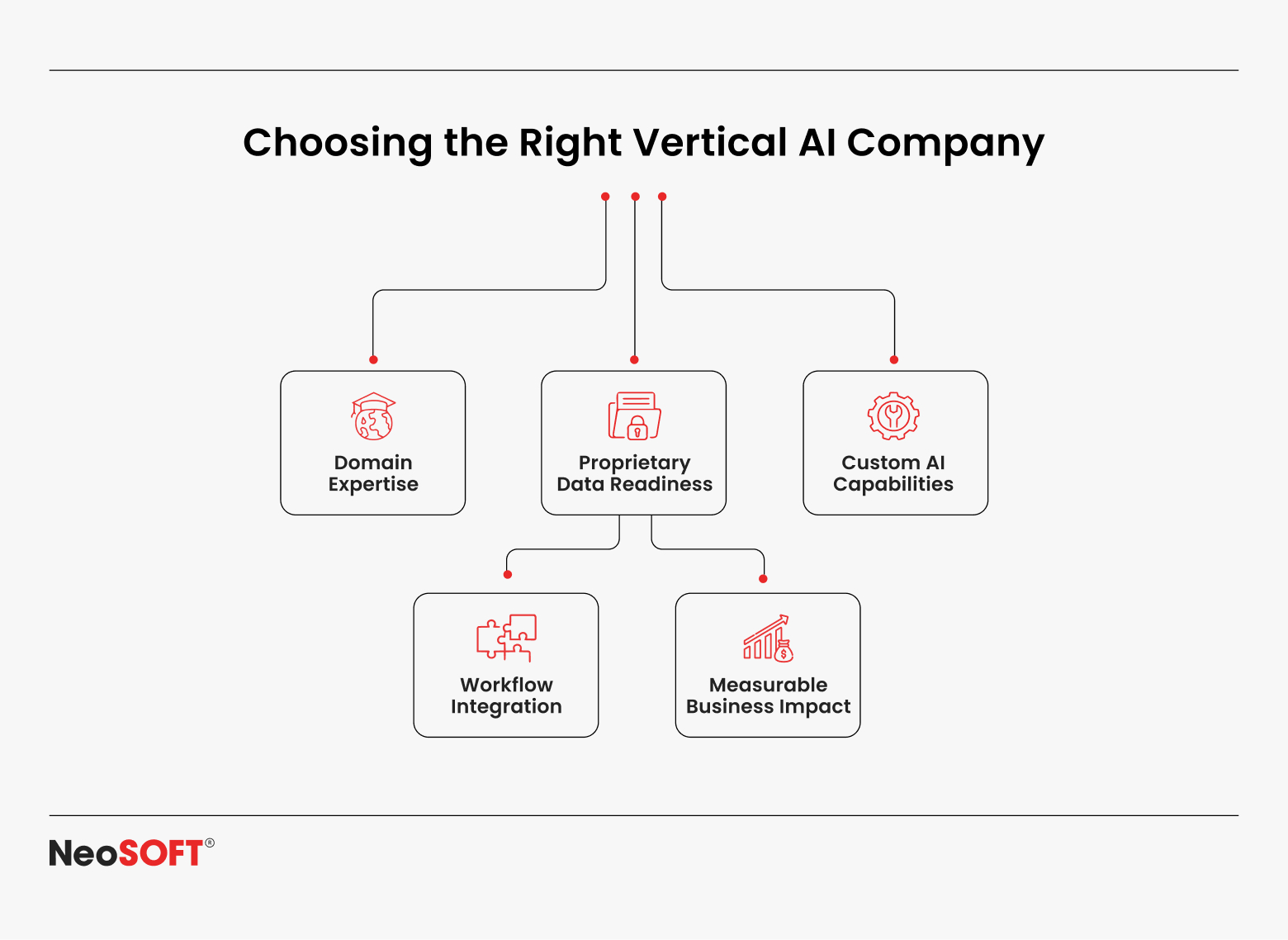
How to Choose the Right Vertical AI Company
With the rise of vertical AI, enterprises must evaluate partners carefully to drive real business value—not just pilots.
Key Criteria
1. Domain Expertise
The right vertical AI provider should understand your industry, requirements, workflows, and any regulatory compliances.
2. Proprietary Data Readiness
They must securely work with your proprietary and unstructured data to deliver differentiated insights.
3. Custom AI Capabilities
Look for model fine-tuning, domain-specific AI, and advanced machine learning—not generic solutions.
4. Workflow Integration
Vertical AI should integrate seamlessly with existing systems and core business workflows.
5. Measurable Business Impact
The solution should focus on automation, efficiency, and clear ROI across mission-critical processes.
Conclusion
Vertical AI by vertical AI agents bridges the gap between the AI and real business needs. Vertical AI combines domain expertise, proprietary data, and workflow integration, delivering significant value where generic AI does not.
Businesses looking for efficiency, resilience, and accuracy, vertical AI solutions help maintain these systems. It is the foundation for long-term sustainable growth.
Whether it’s the legal industry that analyzes contracts, does legal research, or the healthcare industry needing medical imaging support, analyzing electronic records, or the finance industry enabling data analysis and forecasting, NeoSOFT’s solutions will deliver impact.
Future-proof your system with clever and cost-effective AI solutions. Get in touch with us at info@neosofttech.com to find out how our expertise in enterprise AI, custom AI models, and intelligent automation can assist you in achieving your business goals, optimizing your operations, and boosting overall efficiency.
FAQs
What industries are vertical AI applications built for?
Certain industries require vertical AI agents, such as the legal, health, and manufacturing sectors, handle complex data with strict regulatory compliance.
How are vertical AI and horizontal AI different?
Horizontal AI is geared towards offering generic features, whereas vertical AI, in its turn, is deeply embedded in understanding industry-specific jargon, logic, and accuracy in a particular area or domain.
What is an example of vertical AI?
The legal sector may use natural language processing (NLP) for contract analysis, whereas the agricultural sector may employ it for monitoring crop health.
What role do large language models play?
Large Language Models (LLMs) work on complex data, but the value comes from fine-tuning the data and workflow context.
Is vertical AI scalable?
It can be. Vertical AI is scalable if it is built on strong data foundations and integrated with existing tools.