





AI-Driven Digital Transformation: Your Business Is Automated But Not Intelligent. That’s the Real Problem
July 24, 2026
Most corporate boards in 2026 share a common delusion: they believe a digitized business is a smart business. While billions have been funneled into cloud migrations and RPA bots, the result is often just faster versions of old, inefficient processes. You haven’t evolved; you’ve simply paved the cow path.
The Digital Sophistication Trap
If your automated supply chain still requires a human to manage a weather delay, or your CRM sends discount codes to a customer filing a formal complaint, you aren’t intelligent you’re just fast at being stupid.
Checking the Digital Transformation Achieved box on a quarterly report is easy. Anyone with a credit card can automate a process via a SaaS subscription. The hard truth of the mid-2020s is that true intelligence requires the capacity to synthesize information, predict uncertainty, and execute decisions at scale.
Act I: The Dumb Automation Ceiling
The first digital transformation was based on Deterministic Logic: If X happens, do Y. This was appropriate when the world was predictable. In the post-2025 economy of Permanent Volatility, however, this approach is now a liability.
The Fragility of Robotic Process Automation (RPA)
The old way of automating is brittle. It’s based on rules. So if the invoice changes by 5%, the bot breaks. If the customer’s sentiment changes from curious to frustrated, the automated email series continues to annoy the customer with more and more sales pitches – and actually destroys brand equity.
To get beyond this barrier, we need to think about Cognitive Orchestration. This is not just about replacing the human. It’s about replacing the logic that the human was executing. Instead of a script, we need a Reasoning Engine.
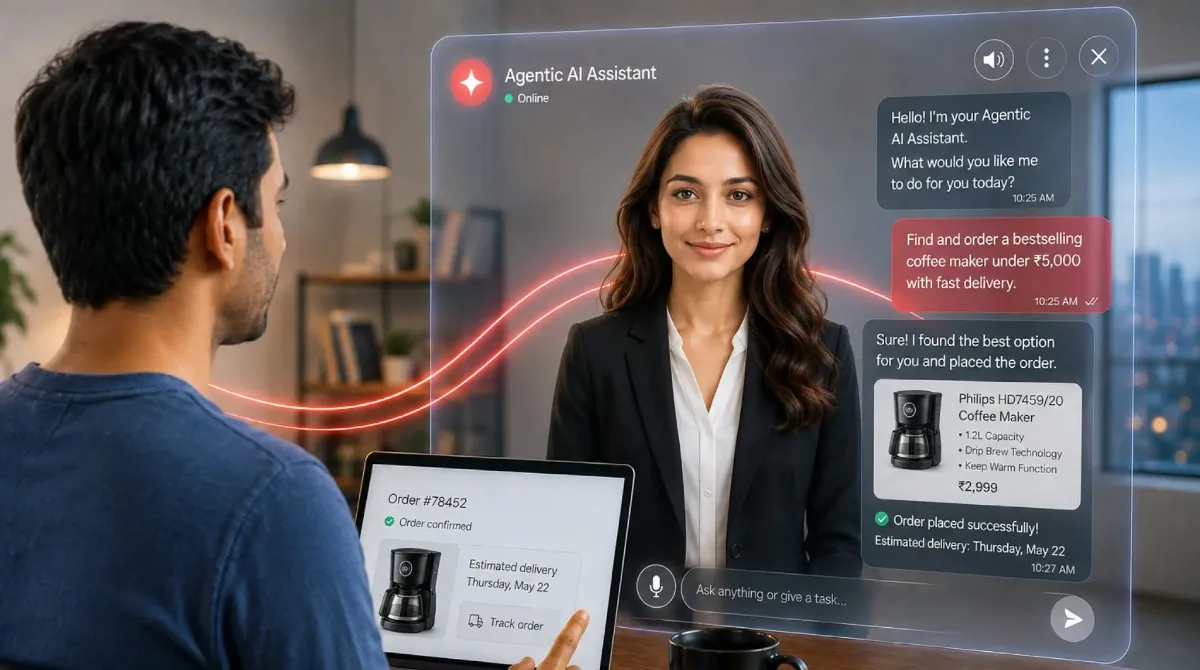
The NeoSOFT Strategic Pivot: We are enabling businesses to move from static scripts to Agentic AI Frameworks. These are not systems that trigger an action, but ones that read the intent of the data. When an intelligent system identifies a 10% price increase from a supplier, it is not just executing an invoice, it is cross-checking the contract, the market rate, and signaling the opportunity for strategic negotiation.
Act II: Context is the Only Competitive Moat
If data is the new oil, then Context is the refinery. Most businesses are swimming in an ocean of Crude Data – petabytes of data that inform them of what is happening, but never why it is happening. An automated business reports sales are down. An intelligent business reports sales are down because of a social media campaign run by our competitor, which impacted our Gen-Alpha consumer in the Pacific Northwest.
Building the Corporate Hippocampus
To make it intelligent, your organization needs a memory system that is centralized. This is the Neural Knowledge Graph. This is the step from Data Lakes to Contextual Fabrics.
- The Technical Layer: Using Vector Databases and Graph Neural Networks, your organization can connect disparate data streams such as customer support tickets, weather data, social media data, and ERP data into one Truth Layer.
- The ROI of Meaning: Once your AI system understands the relationship between these data streams, it moves from Predictive to Prescriptive analytics. It no longer just tells you what might happen. It tells you exactly what to do.
This kind of structural intelligence requires more than a plug and play solution for AI. It requires Advanced Data Engineering and Analytics so that your AI isn’t hallucinating from a patchwork of silos, but instead, it’s making decisions based on a corporate consciousness.
Act III: The Zero-Ops Future and the Invisible Enterprise
The end state of an intelligent transformation is Zero Ops. In a Zero Ops state, the boring parts of your business, the scaling of servers, the balancing of inventory levels, the handling of low-level support requests, all happen in the background.
Autonomous Decision-Making vs. Human-in-the-Loop
In an automated business, humans are the bottleneck. They are the ones that must Approve or Deny. In an intelligent business, humans are the Policy Architects. The Evolution: You set the ethical Guardrails and financial Reward Functions. The AI makes its way through the thousands of micro-decisions that get you there.
- The Result: Your team stops fighting fires and starts designing better matches. This is the highest ROI of any AI investment. As noted in the McKinsey report on the Economic Potential of Generative AI, it’s not about the AI generating poems. It’s about the AI re-architecting the 2.1 billion hours of logic-based work which defines global commerce.
The Verdict: The Intelligence Audit
If you want to know where your business is in terms of Intelligent Enterprise, ask yourself one simple question: If my market changed by 20% tomorrow morning, would my systems automatically adjust to that change, or would I have to call a meeting?
If you have to call a meeting, you are not Intelligent Enterprise – you are merely automated.
To become an Intelligent Enterprise, you are undergoing a deep tissue surgery of your current technology stack. It involves disassembling your current silos and rebuilding them with Predictive Logic as the foundation. We do not just digitize your mess over at NeoSOFT – we engineer your intelligence. We deliver the systems that allow you to stop reacting to the present and start owning the future.
Don’t settle for a faster version of yesterday. Build an intelligent tomorrow. Talk to NeoSOFT’s Digital Transformation Architects today and start your journey from automated to autonomous.
Automation got you this far but intelligence will take you further. See how NeoSOFT is helping enterprises move from rule-based scripts to autonomous decision-making across BFSI, logistics, and beyond. Read our latest blogs here.
Frequently Asked Questions (FAQs)
1. We’ve already spent millions on RPA. Is that investment wasted?
Not at all. Think of RPA as the muscles in your organization. Intelligence (AI) is like the brain. Your RPA bots are still useful for execution, but need to be re-wired to receive commands from an AI Reasoning Engine instead of a script. This is often referred to as Intelligent Process Automation (IPA).
2. How does Intelligence actually impact my bottom line?
This effect is seen in Margin Expansion. Automation results in a small cost savings from speed. Intelligence generates revenue by identifying opportunities that humans are not aware of, like dynamic pricing, predicting churn before it occurs, and hyper-personalizing product bundles that increase Average Order Value (AOV) by 30%+.
3. What is a Reasoning Engine in a business context?
A reasoning engine is an LLM (Large Language Model) and your own data. It is different from a chatbot in that it can reason through a multi-step problem. For example: A shipment is stuck in the Suez Canal. Find three alternative suppliers, compare their shipping costs and carbon footprints, and draft an amendment to our current logistics contract.
4. Is Intelligent Transformation a security risk?
The danger is not the AI, but the danger is uncontrolled AI. Private LLMs and Data Governance Frameworks help you ensure that your ‘Intelligence’ remains your proprietary advantage and never leaks into the public training data sets.
5. Where do I start if my data is currently a mess?
You begin with Semantic Mapping. There is no need to fix all of your data at once. You can choose one ‘High Value Stream’ (for example, Customer Lifetime Value or Supply Chain Resiliency), and create intelligent systems around it. Then, when the ROI is proven, you can scale the intelligence horizontally throughout the enterprise.




Recommended