

Agentic AI: The Next Big Shift in Artificial Intelligence
April 1, 2026
Is your business intelligent enough to think best for itself? What if the technology becomes an enabler to this and enables your systems to finish their tasks in a self-learning mode while your team focuses on growth? In 2026, success depends on the ability of the organizations to act with speed. Many businesses use AI tools for simple content or basic data analysis. However, most companies still rely on traditional AI systems. These older tools cannot move without a human giving a direct instruction. Your employees still spend hours monitoring workflows and managing small tasks.
Agentic AI changes the rules of the game today. This technology allows software to analyze information and choose actions on its own. It helps many businesses work much faster and more efficiently than ever. You move from simple assistance toward true and total business autonomy. This is the next big shift for every modern global organization.
What does Agentic AI mean?
The term agentic AI derives from the concept of agency. Agency means the ability to act independently and make simple decisions. In artificial intelligence, agentic AI systems work like helpful digital assistants. These systems understand situations and try to solve problems step by step. Unlike traditional AI, these systems do not only respond to user prompts.
Instead, agentic AI systems try to complete goals with little human help. They study large amounts of information from many different available data sources. They can also change actions when new data or situations appear.
Modern AI systems support this ability by using several advanced technologies.
- Machine learning models help AI systems find patterns inside very large datasets.
- Natural language processing helps machines better understand human language and normal conversations.
- Powerful generative AI models help analyse data and generate useful results.
Together, these technologies make agentic AI systems more powerful and capable. They help systems work effectively in fast-changing modern digital environments.
How Agentic AI Works?
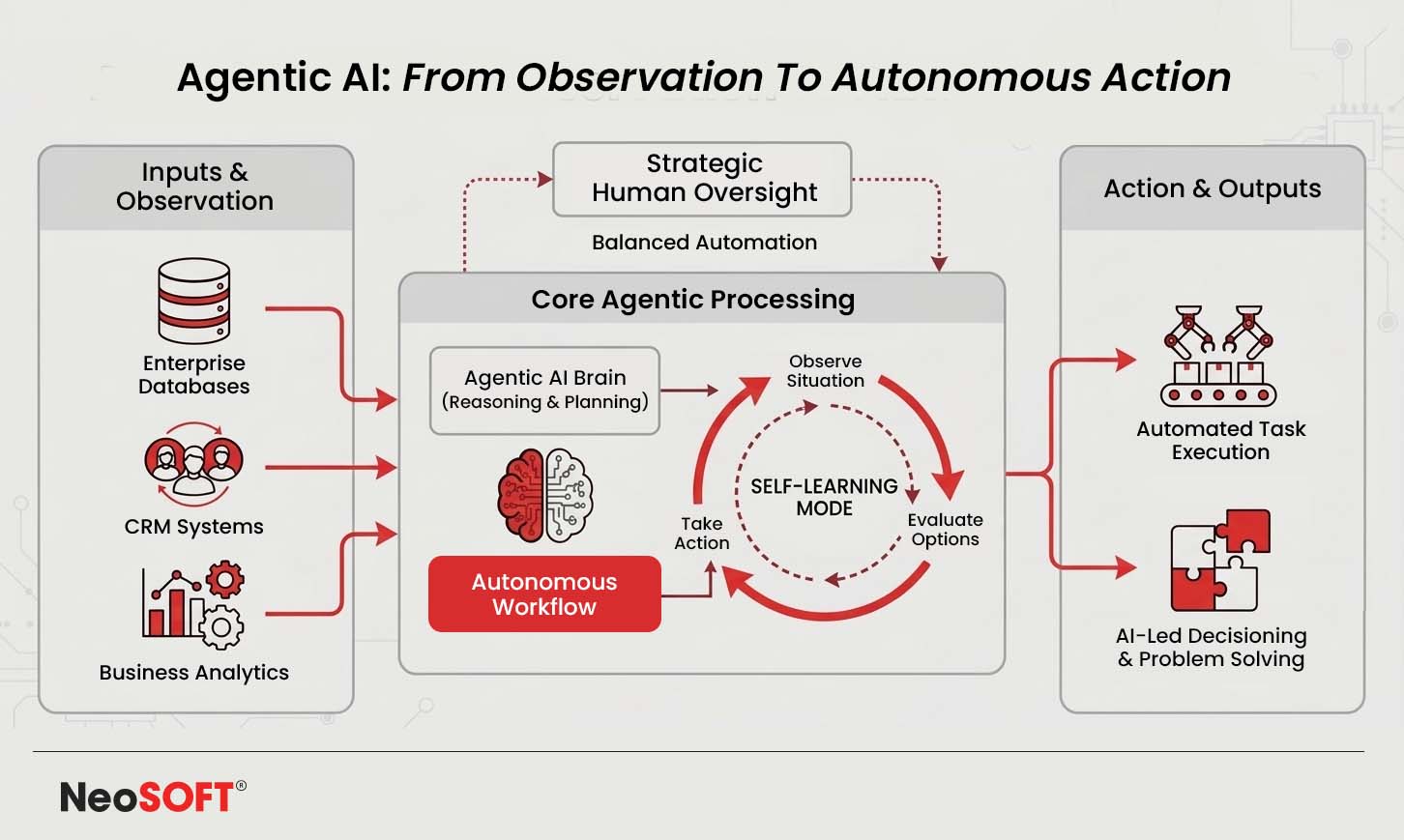
Understanding agentic AI systems starts by learning the role of AI agents. An AI agent is a software program that carefully observes situations. It studies available information and takes actions to complete specific goals. These AI agents continuously collect data and evaluate possible outcomes before acting. Most agentic AI systems connect with enterprise platforms using application programming interfaces. These APIs help AI agents communicate with software platforms and external tools. This connection enables AI systems to easily access important enterprise data.
These systems can access:
- Enterprise databases that store large amounts of business information.
- Customer management systems that contain valuable data on customer interactions and behaviour.
- Business analytics platforms that provide insights for better business decisions.
After examining the available information, the AI model chooses the best action.
Agentic AI v/s Generative AI
To understand agentic AI, compare it with generative AI. Both technologies fall under the broader field of artificial intelligence today. They both work differently. Generative AI primarily focuses on automatically creating new digital content. It can produce text, images, videos, and even programming code.
In comparison, agentic AI systems focus more on actions and decisions. These systems can plan tasks and manage workflows inside business operations. They can also automate complex processes without needing constant human instructions. Instead of only creating content, agentic AI focuses on completing specific goals. These systems review information and take actions to finish assigned tasks. Many modern AI systems combine generative AI models with intelligent AI agents. Generative AI creates information, while AI agents use it to perform actions. This combination makes automation stronger and helps businesses complete tasks efficiently.
Real World Applications of Agentic AI
Organizations in many industries are exploring practical uses of agentic AI. Businesses want automation to improve work efficiency across different departments.
- In software development, smart AI agents help teams with many coding tasks. These systems find hidden bugs and run all the automated tests daily. Smart tools also help improve work for every developer. The technology makes sure that every part of the project works well.
- Financial companies use smart AI systems to find fraud and monitor security. These systems study all transaction data and network activity every single day. Smart tools find suspicious behavior quickly to keep your money safe now. The technology helps businesses stop many digital crimes before they happen today.
- Healthcare organizations also gain benefits from automation powered by AI agents. These AI agents anaylze patient data and help doctors review information faster. This ability supports better judgment and improves overall patient care.
- Retail companies use AI systems to study customer behavior and market trends. These insights help businesses create more personal and engaging customer experiences.
These examples show how agentic AI is slowly changing modern industries today.
The benefits of Agentic AI can be delivered to your business:
Today, many organizations are exploring the growing benefits of agentic AI. One key advantage is the ability to work with very little human involvement. Agentic AI systems can study data and complete many tasks automatically.
Another clear benefit is faster and more efficient data analysis. Modern AI systems can process large amounts of real time information quickly. This ability helps organizations make faster and more accurate business decisions. Automation of complex workflows is another valuable benefit for organizations. Employees can focus more on strategic tasks rather than on repetitive daily work. For many businesses, these improvements show the real benefits of agentic AI.
Challenges and Human Oversight
Even with its many benefits, Agentic AI can still face certain challenges. Some complex situations still need human judgment, which is why human supervision remains important.
- Organizations must regularly monitor automated AI systems during daily operations. Proper monitoring helps reduce possible mistakes in automated decision-making. Clear governance rules also guide the safe use of AI technologies.
- Ethical guidelines help every company use artificial intelligence responsibly. Human oversight is always necessary when a business uses smart autonomous AI agents. People must check the work to ensure the technology is safe. Strict rules help to ensure that these systems follow all the important laws.
- Every business should build a very clear strategy before they use agentic AI. Careful planning helps each organization avoid many risks during the technology setup phase. Leaders must think about their goals before they start any new AI projects. A good plan ensures that the system works well for the whole company.
Balancing automation with human supervision supports safer and more reliable adoption.
Conclusion
The rise of agentic AI shows an important change in artificial intelligence today. Unlike traditional AI, modern agentic AI systems can work independently and intelligently. These systems can review information carefully and make useful decisions automatically. They can also perform many tasks without constant human instructions. Many companies are exploring the benefits of agentic AI systems today. At NeoSOFT, we help organizations build practical and intelligent AI systems.
Explore our AI development services to see how agentic AI improves business operations.
FAQs
- What is agentic AI in simple terms?
Agentic AI refers to AI systems that can act independently and complete tasks automatically. - How is agentic AI different from generative AI?
Generative AI creates content, while agentic AI focuses on decision-making and task execution. - What are the benefits of agentic AI?
The main benefits of agentic AI include automation, faster decisions, and improved operational efficiency. - Where is agentic AI used today?
Industries such as finance, healthcare, software development, and retail use agentic AI systems.