In the traditional world of finance, billion-dollar decisions were often built on a foundation of “gut instinct” and years of experience. But in today’s hyper-accelerated market, relying on the past to navigate the future is a recipe for obsolescence.
The financial industry is now reaching a very big turning point. Many top leaders say smart tools are helping them make money. A massive gap is growing between fast and very slow companies. You cannot just look at things that happened in the past. Your business must start predicting what will happen on the next day. Firms that only look backward are losing their place in the market. If you do not change now, your company will become irrelevant. Success belongs to those who use data to see the future clearly.
The Great Shift moves from Hindsight to Foresight
Data analytics is no longer a “back-office” function; it is the new currency of finance. We have moved past the era of simple historical reporting. Modern firms are transforming into sophisticated, data-driven organizations that use precision analytics like a surgeon uses a scalpel.
The difference lies in the Strategic Overhaul. Leading firms are using data to:
Move beyond human speed: Executing trades and identifying patterns in milliseconds.
Remove emotional bias: Using disciplined mathematical models to navigate market volatility.
Anticipate, don’t react: Solving customer needs before the customer even identifies them.
The Reality of a Predictive Powerhouse
To understand why predictive analytics is the ultimate survival tool, we have to look at where it hits the ground. It isn’t just about “better charts” – it’s about fundamentally changing how the business survives and thrives.
Proactive Fraud Prevention
Big banks measure success by how much money they save every second. Without smart tools, staff can only check a very small number of deals. Human teams often miss the clever tricks that modern digital thieves use. Smart systems look at how you touch and move your phone screen. The system stops a bad money transfer in just a split second. This keeps the bank safe and protects the money of every client.
Smart Risk Management
Banks must keep extra cash in a vault for unexpected bad events. In the past, the future was hard to see and very blurry. This forced banks to keep a lot of money sitting totally idle. Now, smart models show exactly where the biggest risks are hiding today. The bank can safely move millions of dollars out of their reserves. This money can now go to work to help the business grow.
Hyper-Personalization
Old ways of sending the same ads to everyone are now dead. Rich clients will leave if you send them a boring, generic offer. Smart data tools can spot major life events through your spending habits. If you buy home tools, the bank offers a home repair loan. The offer feels like a real talk instead of a cold ad. This builds deep trust and keeps customers happy for a long time.
The Tech Stack: Popping the Hood
To turn raw data into smart decisions, you need high-performance technology. If your foundation is weak, your results will be unreliable.
The Foundation (Data Engineering): Using automated pipelines to clean and structure data. Without clean “fuel,” your analytics engine won’t start.
The Brains (Machine Learning & AI): This is where raw numbers become predictions. Whether it’s credit scoring or natural language processing for market news, AI is the onboard computer making the split-second calls.
The Dashboard (Business Intelligence): Tools like Power BI or Tableau translate complex algorithms into actionable insights for human decision-makers.
How to Stay in the Lead
Success in this new landscape requires a disciplined roadmap for every firm. You cannot simply buy smart tools; you must implement them correctly.
Discovery: You must connect your data goals to high-value business problems.
Governance: Always ensure your data is secure and follow every strict rule.
Validation: You must test your models often to keep them very accurate.
Deployment: Move your smart tools into the real world for fast results.
These steps will help your business stay ahead of the competition. Finding a strong partner will help you grow much faster today. The industry has already changed so you must start your journey now.
Build a Better Future Today
The growth of the global financial data market is now very fast. There is a real gap because expert data scientists are hard to find. For most firms, the path to survival is not building from scratch. Finding a strong partner is the best way to grow your business. A partner provides the expert skills you need to win the race. The financial industry has already changed into a very digital world today. You must decide if you will lead or become a memory. Start your data journey with NeoSOFT to build a much stronger future. We can turn your raw data into a powerful weapon for success. Contact NeoSOFT now to lead the way in the new predictive era.
In the next minute, your institution will process thousands of transactions. In that same window, an automated digital threat can bypass a traditional perimeter. If your response depends on a human middleman, the damage is already done before the first alert is read.
Traditional security was built for a world of physical walls and slow-moving paperwork. Today, the shift to Hybrid Cloud has replaced those walls with infinite digital entry points. We are moving from an era of “watching for threats” to a mandatory era of “autonomous prevention.”
The Response Gap: Your Most Dangerous Liability
In the financial sector, the time to detect a breach is often measured in days. However, modern digital attacks move in the blink of an eye. While teams sift through a fog of “alert fatigue,” automated bots can drain digital vaults and compromise data in a heartbeat.
For a modern bank, being “late” is functionally the same as being “defenseless.” Relying on a human analyst to approve a security response creates a bottleneck that hackers love to exploit. By the time a ticket is raised, the ledger has cleared, and the attacker is gone.
From Manual Watching to Autonomous Acting
The solution is not “more security staff”; it is Agentic AI. This technology marks the shift from a system that tells you there is a fire to one that has already extinguished it before you smell the smoke.
Autonomous Cloud Defense uses machine learning to understand exactly what “normal” behavior looks like for your bank. When a deviation occurs—like an unusual API call from a global branch—the AI doesn’t just send an email. It severs the connection instantly. This is security that thinks and acts at the speed of the threat itself.
The Impact of an Autonomous Guardrail
Instant Neutralization: Threats are stopped in the same moment they are identified.
Regulatory Resilience: Automated systems ensure you stay ahead of strict mandates without manual effort.
Resource Optimization: Eliminates the “noise” of false alarms, allowing your top talent to focus on high-level growth strategy.
Unshakeable Trust: Your reputation remains protected because your systems stay online and secure, regardless of the global threat landscape.
Real-World Proof: The Self-Defending Vault
A leading retail bank recently integrated Real-Time AI into its multi-cloud environment. During a sophisticated attack that bypassed traditional firewalls, the AI identified the pattern across thousands of global endpoints. The system blocked the source in a fraction of a second, preventing significant fraud losses in a single afternoon.
Key Takeaways
Speed is the Metric: If your security cannot act instantly, it is not “real-time.”
AI Handles the Tactics: Let technology handle the defense so your leadership can handle the business expansion.
Modern Cloud Demands AI: You cannot protect a modern digital environment with manual workflows from the past.
Conclusion
The window for “wait and see” has closed. For financial leaders, the choice is no longer between security vendors, but between manual vulnerability and autonomous resilience.
Is your bank built to withstand a breach, or has it just been lucky so far? Secure your future with NeoSOFT and redefine your security with the power of Real-Time AI.
Is your business intelligent enough to think best for itself? What if the technology becomes an enabler to this and enables your systems to finish their tasks in a self-learning mode while your team focuses on growth? In 2026, success depends on the ability of the organizations to act with speed. Many businesses use AI tools for simple content or basic data analysis. However, most companies still rely on traditional AI systems. These older tools cannot move without a human giving a direct instruction. Your employees still spend hours monitoring workflows and managing small tasks.
Agentic AI changes the rules of the game today. This technology allows software to analyze information and choose actions on its own. It helps many businesses work much faster and more efficiently than ever. You move from simple assistance toward true and total business autonomy. This is the next big shift for every modern global organization.
What does Agentic AI mean?
The term agentic AI derives from the concept of agency. Agency means the ability to act independently and make simple decisions. In artificial intelligence, agentic AI systems work like helpful digital assistants. These systems understand situations and try to solve problems step by step. Unlike traditional AI, these systems do not only respond to user prompts.
Instead, agentic AI systems try to complete goals with little human help. They study large amounts of information from many different available data sources. They can also change actions when new data or situations appear.
Modern AI systems support this ability by using several advanced technologies.
Machine learning models help AI systems find patterns inside very large datasets.
Natural language processing helps machines better understand human language and normal conversations.
Powerful generative AI models help analyse data and generate useful results.
Together, these technologies make agentic AI systems more powerful and capable. They help systems work effectively in fast-changing modern digital environments.
How Agentic AI Works?
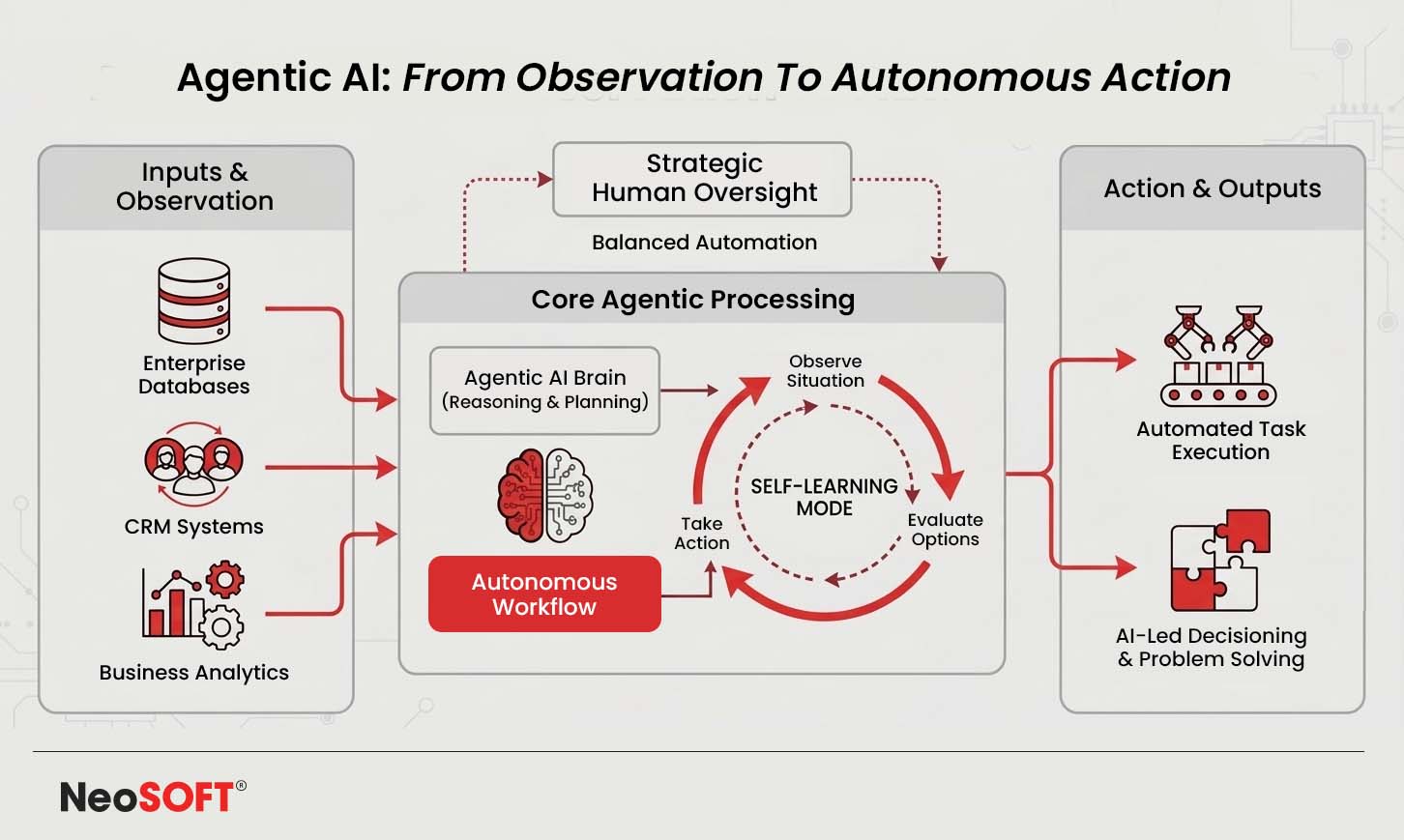
Understanding agentic AI systems starts by learning the role of AI agents. An AI agent is a software program that carefully observes situations. It studies available information and takes actions to complete specific goals. These AI agents continuously collect data and evaluate possible outcomes before acting. Most agentic AI systems connect with enterprise platforms using application programming interfaces. These APIs help AI agents communicate with software platforms and external tools. This connection enables AI systems to easily access important enterprise data.
These systems can access:
Enterprise databases that store large amounts of business information.
Customer management systems that contain valuable data on customer interactions and behaviour.
Business analytics platforms that provide insights for better business decisions.
After examining the available information, the AI model chooses the best action.
Agentic AI v/s Generative AI
To understand agentic AI, compare it with generative AI. Both technologies fall under the broader field of artificial intelligence today. They both work differently. Generative AI primarily focuses on automatically creating new digital content. It can produce text, images, videos, and even programming code.
In comparison, agentic AI systems focus more on actions and decisions. These systems can plan tasks and manage workflows inside business operations. They can also automate complex processes without needing constant human instructions. Instead of only creating content, agentic AI focuses on completing specific goals. These systems review information and take actions to finish assigned tasks. Many modern AI systems combine generative AI models with intelligent AI agents. Generative AI creates information, while AI agents use it to perform actions. This combination makes automation stronger and helps businesses complete tasks efficiently.
Real World Applications of Agentic AI
Organizations in many industries are exploring practical uses of agentic AI. Businesses want automation to improve work efficiency across different departments.
In software development, smart AI agents help teams with many coding tasks. These systems find hidden bugs and run all the automated tests daily. Smart tools also help improve work for every developer. The technology makes sure that every part of the project works well.
Financial companies use smart AI systems to find fraud and monitor security. These systems study all transaction data and network activity every single day. Smart tools find suspicious behavior quickly to keep your money safe now. The technology helps businesses stop many digital crimes before they happen today.
Healthcare organizations also gain benefits from automation powered by AI agents. These AI agents anaylze patient data and help doctors review information faster. This ability supports better judgment and improves overall patient care.
Retail companies use AI systems to study customer behavior and market trends. These insights help businesses create more personal and engaging customer experiences.
These examples show how agentic AI is slowly changing modern industries today.
The benefits of Agentic AI can be delivered to your business:
Today, many organizations are exploring the growing benefits of agentic AI. One key advantage is the ability to work with very little human involvement. Agentic AI systems can study data and complete many tasks automatically.
Another clear benefit is faster and more efficient data analysis. Modern AI systems can process large amounts of real time information quickly. This ability helps organizations make faster and more accurate business decisions. Automation of complex workflows is another valuable benefit for organizations. Employees can focus more on strategic tasks rather than on repetitive daily work. For many businesses, these improvements show the real benefits of agentic AI.
Challenges and Human Oversight
Even with its many benefits, Agentic AI can still face certain challenges. Some complex situations still need human judgment, which is why human supervision remains important.
Organizations must regularly monitor automated AI systems during daily operations. Proper monitoring helps reduce possible mistakes in automated decision-making. Clear governance rules also guide the safe use of AI technologies.
Ethical guidelines help every company use artificial intelligence responsibly. Human oversight is always necessary when a business uses smart autonomous AI agents. People must check the work to ensure the technology is safe. Strict rules help to ensure that these systems follow all the important laws.
Every business should build a very clear strategy before they use agentic AI. Careful planning helps each organization avoid many risks during the technology setup phase. Leaders must think about their goals before they start any new AI projects. A good plan ensures that the system works well for the whole company.
Balancing automation with human supervision supports safer and more reliable adoption.
Conclusion
The rise of agentic AI shows an important change in artificial intelligence today. Unlike traditional AI, modern agentic AI systems can work independently and intelligently. These systems can review information carefully and make useful decisions automatically. They can also perform many tasks without constant human instructions. Many companies are exploring the benefits of agentic AI systems today. At NeoSOFT, we help organizations build practical and intelligent AI systems.
Agentic AI refers to AI systems that can act independently and complete tasks automatically.
How is agentic AI different from generative AI?
Generative AI creates content, while agentic AI focuses on decision-making and task execution.
What are the benefits of agentic AI?
The main benefits of agentic AI include automation, faster decisions, and improved operational efficiency.
Where is agentic AI used today?
Industries such as finance, healthcare, software development, and retail use agentic AI systems.
We use cookies on our website to give you the most relevant experience by remembering your preferences and repeat visits. By clicking “Accept All”, you consent to the use of ALL the cookies. However, you may visit "Cookie Settings" to provide a controlled consent.
This website uses cookies to improve your experience while you navigate through the website. Out of these, the cookies that are categorized as necessary are stored on your browser as they are essential for the working of basic functionalities of the website. We also use third-party cookies that help us analyze and understand how you use this website. These cookies will be stored in your browser only with your consent. You also have the option to opt-out of these cookies. But opting out of some of these cookies may affect your browsing experience.
Necessary cookies are absolutely essential for the website to function properly. These cookies ensure basic functionalities and security features of the website, anonymously.
Cookie
Duration
Description
cookielawinfo-checkbox-analytics
11 months
This cookie is set by GDPR Cookie Consent plugin. The cookie is used to store the user consent for the cookies in the category "Analytics".
cookielawinfo-checkbox-functional
11 months
The cookie is set by GDPR cookie consent to record the user consent for the cookies in the category "Functional".
cookielawinfo-checkbox-necessary
11 months
This cookie is set by GDPR Cookie Consent plugin. The cookies is used to store the user consent for the cookies in the category "Necessary".
cookielawinfo-checkbox-others
11 months
This cookie is set by GDPR Cookie Consent plugin. The cookie is used to store the user consent for the cookies in the category "Other.
cookielawinfo-checkbox-performance
11 months
This cookie is set by GDPR Cookie Consent plugin. The cookie is used to store the user consent for the cookies in the category "Performance".
viewed_cookie_policy
11 months
The cookie is set by the GDPR Cookie Consent plugin and is used to store whether or not user has consented to the use of cookies. It does not store any personal data.
Functional cookies help to perform certain functionalities like sharing the content of the website on social media platforms, collect feedbacks, and other third-party features.
Performance cookies are used to understand and analyze the key performance indexes of the website which helps in delivering a better user experience for the visitors.
Analytical cookies are used to understand how visitors interact with the website. These cookies help provide information on metrics the number of visitors, bounce rate, traffic source, etc.
Advertisement cookies are used to provide visitors with relevant ads and marketing campaigns. These cookies track visitors across websites and collect information to provide customized ads.