For years, financial institutions measured digital transformation through faster transactions, mobile adoption, and automation rates. Yet behind increasingly sophisticated banking interfaces, critical decisions still depend on fragmented data, disconnected risk engines, and manual intervention.
In 2026, artificial intelligence is challenging this operating model. The opportunity extends beyond improving individual processes to connecting financial intelligence with real-time execution, risk controls, and business decisions.
This evolution is particularly significant across the Middle East, where open finance infrastructure, digital banking competition, and cross-border payment requirements are converging.
As Dubai FinTech Summit 2026, scheduled for November 2–3 at Madinat Jumeirah, brings financial leaders together, five AI shifts reveal where banking, payments, and FinTech infrastructure must evolve.
1. Agentic AI: From Banking Automation to Decision Orchestration
Conventional banking automation executes predefined instructions. Agentic AI introduces systems that interpret objectives, coordinate workflows, retrieve relevant information, and recommend or execute authorized actions.
Consider commercial lending. Financial assessment, document verification, compliance screening, and credit evaluation typically operate across multiple systems.
An agentic workflow could coordinate these activities, identify missing documentation, retrieve authorized customer information, and assemble a credit assessment for review.
Three architectural capabilities become critical:
Policy-bound autonomy: Define which activities agents can perform independently and which require approval.
Multi-system orchestration: Connect core banking, CRM, document management, and compliance applications through secured APIs.
Execution traceability: Record information accessed, tools invoked, decisions proposed, and actions completed.
The distinction between preparing a credit recommendation and approving exposure remains essential.
For financial institutions, the opportunity lies in reducing operational handoffs without weakening accountability.
Business impact: Measure exception-resolution time, straight-through processing, cost per application, and human intervention rates.
2. AI-Native Payments: When Software Becomes the Transaction Initiator
Payment systems were designed primarily around transactions initiated by people or merchants. Agentic commerce introduces another participant: software acting under delegated authority.
Visa’s 2026 Agentic Ready initiative illustrates how payment networks are preparing issuers to support AI-initiated transactions within controlled environments.
Imagine a corporate procurement agent authorized to purchase software subscriptions. It may evaluate suppliers, compare pricing, and initiate payment. But how does the issuer distinguish an authorized purchase from an agent exceeding its mandate?
AI-native payment infrastructure requires four control layers:
Agent identity: Establish which application initiated the transaction.
Delegated authorization: Validate spending limits, merchant restrictions, and approval conditions.
Transaction intelligence: Evaluate behavioral anomalies and contextual risk signals.
Payment orchestration: Select eligible processing routes based on cost, availability, and settlement requirements.
These capabilities also matter for cross-border transactions, where routing decisions must account for foreign exchange costs, liquidity, sanctions controls, and network availability.
The opportunity is not merely faster payments. It is enabling machine-initiated financial activity without surrendering control over transaction authority.
For banks and payment service providers, authorization success rates, fraud losses, and settlement costs become essential performance indicators.
Financial crime rarely occurs as one isolated suspicious transaction. Fraud networks exploit relationships between devices, beneficiaries, accounts, identities, and payment channels.
Traditional detection environments frequently evaluate these signals independently, limiting their ability to recognize coordinated behavior.
AI-driven financial crime platforms increasingly combine behavioral analytics, graph intelligence, and real-time event processing to produce contextual risk assessments.
Consider an account initiating an international transfer shortly after a device change and the addition of a new beneficiary. Each event might appear legitimate individually. Their combined sequence warrants closer examination.
An effective risk-intelligence architecture should incorporate:
Entity resolution: Connect related accounts, identities, devices, and counterparties.
Graph-based detection: Identify suspicious relationships and coordinated transaction patterns.
Investigation feedback: Use verified outcomes to monitor and improve detection performance.
The challenge is balancing detection sensitivity against legitimate customer friction.
Excessive alerts increase investigation costs, while overly aggressive intervention can disrupt valuable customer relationships.
Modern banking and financial technology solutions must therefore connect transaction processing, intelligence, and risk controls rather than treating fraud prevention as an isolated application.
Business impact: Evaluate confirmed fraud losses, false-positive rates, investigation turnaround, and customer abandonment.
4. Open Finance and AI: Turning Financial Data Into Contextual Decisions
Open finance is expanding the information available for financial decision-making, subject to customer permission and applicable regulatory requirements.
The UAE’s Open Finance Regulation provides a framework for API-enabled financial data sharing and transaction initiation through a regulated infrastructure.
For banks and FinTech providers, the next opportunity is applying AI to authorized financial information across products and institutions.
Consider a small business maintaining accounts with several banks. An intelligent financial platform could consolidate permitted account information, identify recurring liquidity shortages, and recommend suitable working-capital options.
Three capabilities determine whether this model can scale:
Consent-aware data engineering: Enforce customer permissions throughout collection, processing, and access.
Explainable recommendations: Connect financial advice and eligibility assessments to verifiable information.
However, incomplete datasets, outdated permissions, and inconsistent financial classifications can undermine model accuracy.
AI-powered personalization must also avoid inappropriate product targeting and discriminatory lending outcomes.
The strategic advantage comes from delivering relevant financial decisions at the point of need, not simply generating more personalized product offers.
For implementation teams, this requires strong API infrastructure, data quality management, and continuous model monitoring.
5. Governed AI: Embedding Accountability Into Financial Architecture
As AI systems gain operational authority, governance must become an architectural capability rather than a compliance review conducted after deployment.
The Financial Stability Board’s October 2026 guidance identifies 12 sound practices covering AI governance, risk management, model performance, human oversight, and third-party dependencies.
For financial enterprises, the implications extend into production engineering.
Five controls deserve immediate architectural attention:
Model accountability: Maintain ownership, inventories, approved use cases, and version histories.
Access enforcement: Restrict models and agents to authorized data and execution tools.
A credit recommendation, payment restriction, or suspicious-activity alert should remain reconstructable and auditable.
The real test of enterprise AI maturity is whether an institution can explain, control, and reproduce consequential decisions at scale.
From AI Experimentation to the Intelligent Financial Enterprise
These five shifts point toward a common transformation: financial institutions must connect intelligence, execution, and governance across their technology landscape.
The transition requires more than deploying additional models. It demands dependable integration between existing banking infrastructure and emerging intelligent capabilities.
Although not an example of fully autonomous banking, it demonstrates the foundational integration required before institutions can safely introduce greater AI-driven decision-making.
For financial leaders, three questions should guide investment priorities:
Which high-value decisions remain constrained by fragmented systems?
Where can intelligence improve outcomes without introducing unacceptable risk?
What infrastructure is required to move successful AI applications into governed production?
Dubai FinTech Summit 2026 provides a timely forum for examining these challenges across banking, payments, and financial technology.
The next competitive advantage will belong to institutions that can translate intelligence into reliable financial decisions while retaining control over every consequential action.
In an era where technology and the financial landscape are always changing, effective risk management has turned into a strategic requirement for financial firms as well as an expectation. For financial institutions to maintain stability and safeguard their assets, comprehensive risk management protocols must be put in place.
Given the emergence of Bitcoin and other cryptocurrencies, trading in securities, and other cutting-edge technologies, the degree of complexity of the financial sector is growing. Businesses used to rely on historical data and industry experience to address credit, market volatility, fraud, and operational risks. This has rendered conventional risk management techniques unable to adequately address the variety of threats present in the data-driven, high-pressure world of today. These methods are not flexible enough to adapt to new risks and situations.
For companies that want to stay ahead of the technological development curve, predictive analytics is essential. This would facilitate preemptive and real-time risk detection, and decision-making based on data, hence offering a flexible approach to operational risk management.
This blog briefly outlines the many ways that predictive analytics is revolutionizing risk administration in the financial sector, its advantages, tools, and methods of use. The content is useful for risk analysts, financial specialists, investors, and industry stakeholders who want to use data-driven approaches to improve their risk management strategies.
Defining Predictive Analytics
Banking and insurance companies can improve their capacity to recognize, anticipate, and respond to market volatility more rapidly and competently by implementing predictive analytics. It blends data mining, statistics, artificial intelligence, and machine learning techniques.
By utilizing it to spot new trends and patterns that more traditional analysis techniques would tend to overlook, businesses can employ it to spot market threats and enhance their decision-making.
Data mining – Extracting patterns and insights from enormous amounts of data.
Machine learning – Data-driven algorithms that enhance predictions over time with no need for explicit programming.
Statistical analysis – Time-series forecasting, regression analysis, and classification are examples of models used to examine data and predict events.
Predictive analytics relies on past data significantly. By studying historical data and patterns, these algorithms are able to predict actions and results in the future. This is especially valuable in finance, where market circumstances, consumer habits, and risk patterns frequently recur or develop in predictable ways.
Predictive analytics is used in financial services for numerous different purposes. Some of them are given below:
Fraud detection – Real-time detection of suspicious activities using past patterns.
Customer retention – Identifying clients who are likely to quit so that businesses can take proactive measures to retain them.
Credit scoring – Estimating the probability of default by examining a person’s financial background and inclinations.
Market risk forecasting – Utilizing historical performance data to predict shifts in market patterns and stock prices.
Predictive Analytics’ Numerous Advantages
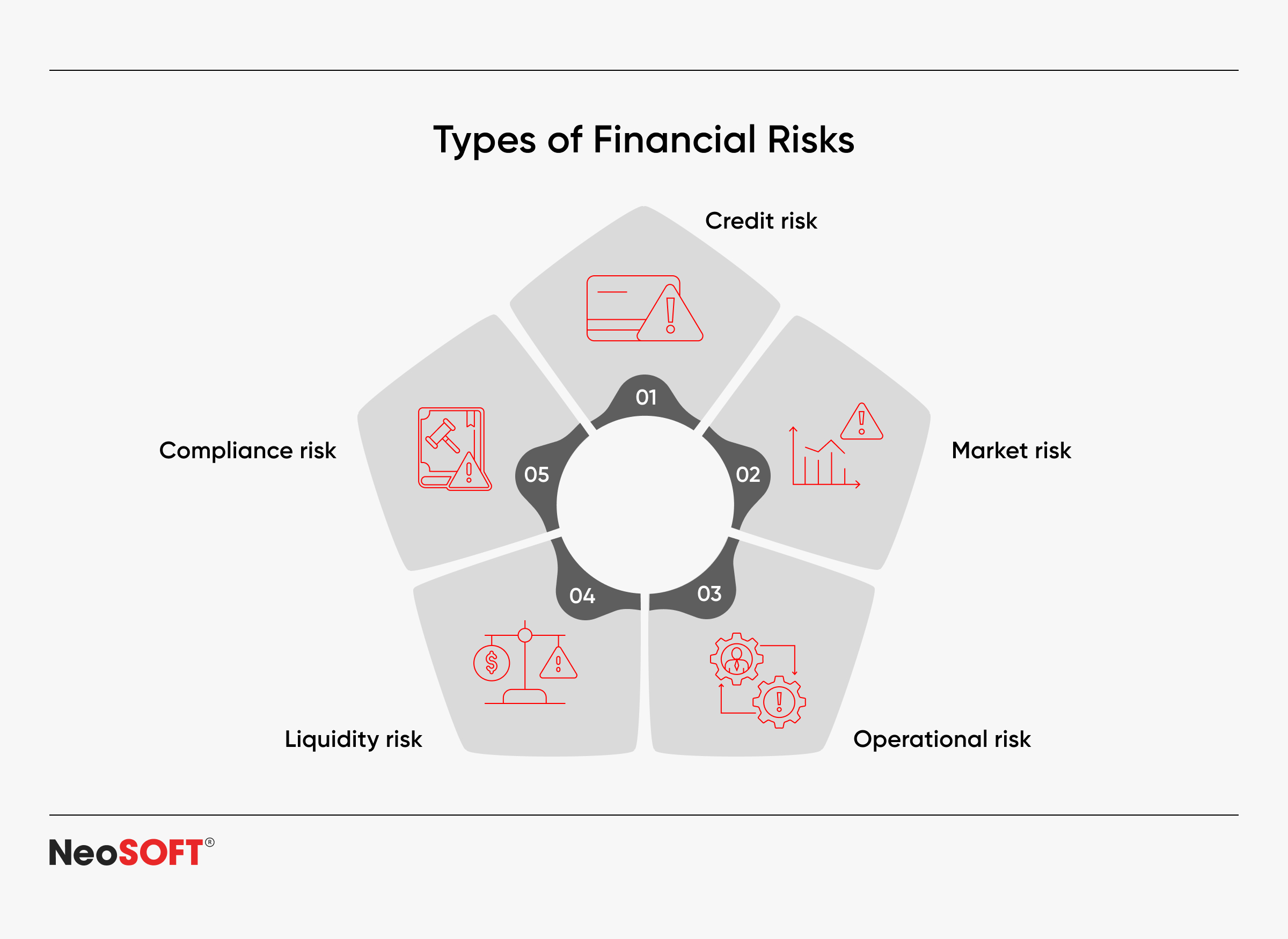
Financial and banking institutions are vulnerable to several forms of risk almost constantly. These include:
Operational risk – The potential for financial processes to be disrupted by external events, human error, or malfunctioning internal systems.
Market risk – Losses can occur as a result of shifts in market factors such as stock prices, interest rates, and foreign exchange rates.
Compliance risk – Penalties, punishments, and reputational harm could arise from breaking regulatory norms.
Credit risk – The possibility that a borrower might default on a loan or fail to uphold their end of the financial contract.
Liquidity risk – The possibility that an organization won’t have enough cash flow to cover its immediate financial obligations.
Financial services organizations have so far employed risk models, which are based on specified criteria and historical data, to mitigate operational and financial risk. Potential losses were anticipated and countered using approaches like scenario analysis, credit risk assessments, and stress testing.
These systems frequently fail to keep up with changing market conditions since they depend upon static data. Furthermore, rather than proactively detecting and managing risks in actual time, they are reactive, addressing concerns only after they arise.
Predictive analytics is a highly effective tool for modern financial risk management techniques in this regard. Financial organizations may use predictive models, enormous data sets, and real-time statistical analysis thanks to predictive analysis. This allows them to manage risks by:
Preparing for potential hazards before they arise.
Determining obscure trends and new dangers that conventional models might miss.
Modifying risk models on a regular basis in response to fresh facts.
Automating risk identification and mitigation processes to improve operational efficiency.
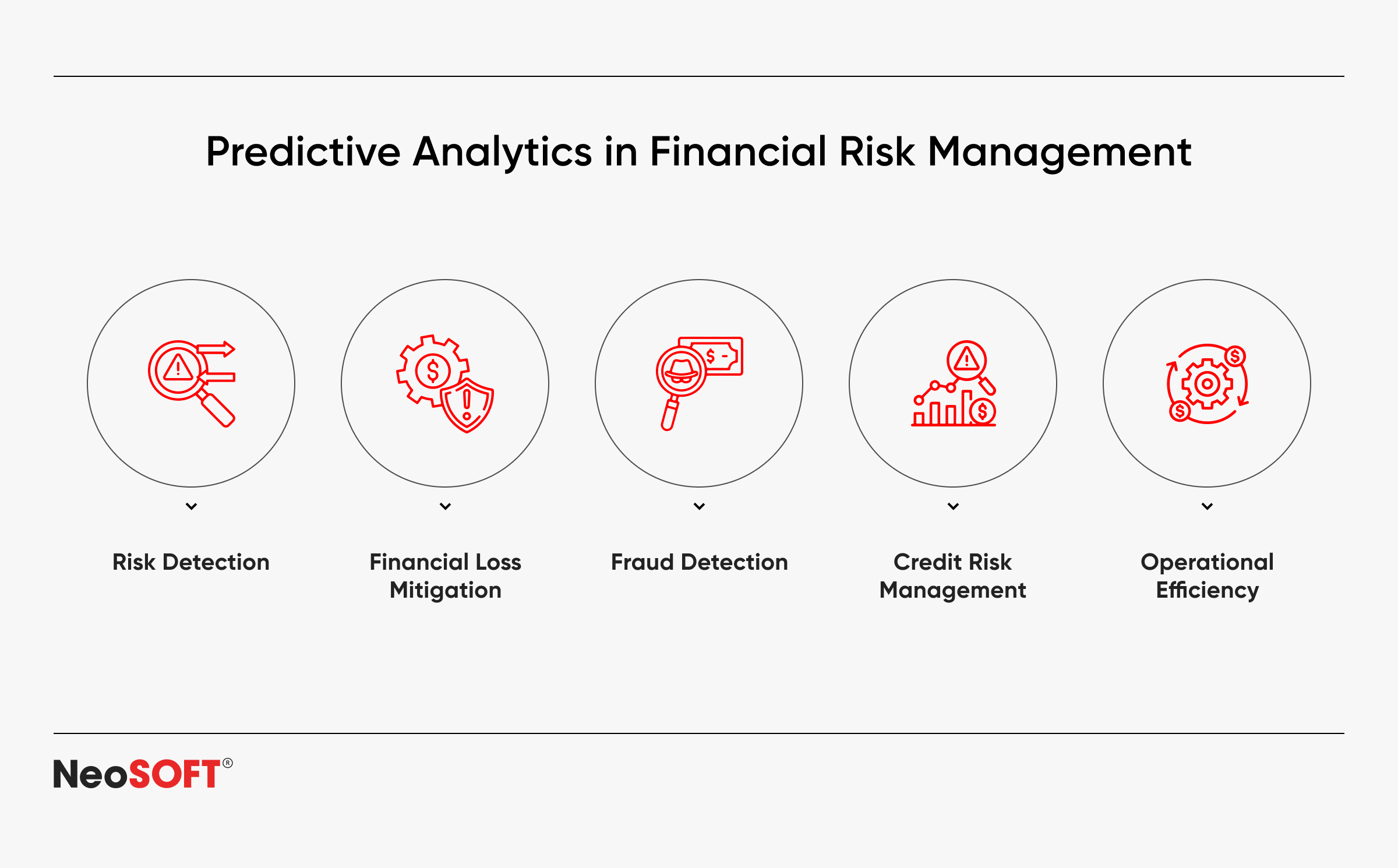
Predictive Analytics in Financial Risk Management
Risk Detection
Compared to conventional risk avoidance techniques, predictive analytics assists financial organizations in identifying possible risks and hazards far earlier. Predictive models can reveal latent patterns and trends in massive datasets analyzed from multiple sources (market data, transaction histories, consumer habits, etc.). This makes it possible for businesses to anticipate new risks, such as changes in the market or credit defaults, and to take measures before those potential risks can worsen.
Financial Loss Mitigation
The ability of predictive analytics to anticipate unstable markets and risky deals is among its biggest benefits. Financial institutions are enabled to make better decisions about their investment portfolios and avoid holding assets that may underperform or carry too much risk by anticipating changes in asset values and markets in the future. This proactive approach can significantly lower financial losses, especially in times of market or financial volatility.
Fraud Detection
Predictive analytics provides real-time fraud detection and risk avoidance by continuously monitoring transactional data. Machine learning algorithms are trained to identify trends in valid transactions as well as evidence of fraudulent activity. These models may change and grow by using new data, recognizing intricate fraudulent schemes and identifying financial risks as they emerge. Financial organizations can avoid questionable transactions and prevent costly exposures by detecting anomalies and suspicious movements as they occur.
Credit Risk Management
Predictive analytics dramatically improves credit rating and loan default projections in financial markets. Predictive models can provide more accurate assessments of various factors of a borrower’s creditworthiness by assessing consumer data, financial backgrounds, and even unusual data elements (such as internet habits or social media activity). This enables financial companies to make more informed lending decisions, minimizing the chance of default and boosting overall loan portfolio profitability.
Operational Efficiency
Another way predictive analytics adds value to asset management is by automating risk-related processes. Rather than depending on manual risk mitigation processes and occasional risk assessments, predictive algorithms may examine data in real-time and indicate potential dangers. This automation decreases the workload of risk control teams, optimizes operations, and guarantees that key risk mitigation decisions are made more quickly and precisely.
The Software Behind Predictive Analytics
Predictive analytics makes use of a wide range of cutting-edge tech to analyze large amounts of data and generate accurate forecasts based on the same. Owing to these tools, financial companies can manage risk with more knowledge and data-driven decision-making. A brief outline of the main tools and technologies enabling predictive analytics is provided below.
Key Technologies
Artificial Intelligence – Predictive analytics relies heavily on AI to help systems learn from data, identify trends, and make judgments. AI enables predictive models to analyze more data and continuously adapt and improve over a period of time. This is helpful for managing adaptive risk in different industries, not just banking and finance.
Machine Learning – The process of creating algorithms that, without explicit programming, can learn from and anticipate outcomes based on data is known as machine learning. Since ML models can handle big datasets quickly and accurately, they are usually used to analyze investment risk, detect fraud, and obtain credit risk ratings.
Big Data Analytics – Financial organizations produce massive volumes of data from their dealings with customers and the market. Big data analytics can facilitate the handling, processing, and analysis of massive amounts of information and insights, which helps businesses uncover trends and insights that were previously unknown or overlooked. Big data can be used by financial institutions for real-time analytics, risk identification and speeding up decision-making.
Common Tools and Platforms
Python – A well-liked programming language for ML and data analysis, Python has many libraries that make it easier to create predictive models, including Scikit-learn, TensorFlow, and Pandas.
Apache Spark – It is a general-purpose, fast cluster computing system with ML libraries and data processing capabilities. Spark performs exceptionally well in massive data processing and real-time analytics.
Hadoop – Hadoop is a system used frequently in big data analysis for the distributed processing and storing of massive datasets. It is an essential tool for managing massive volumes of financial data since it allows businesses to store and examine enormous amounts of data.
Tableau – A data visualization tool that assists financial institutions in presenting prediction model insights in a comprehensible and useful manner. It is frequently used to create reports and dashboards based on the outcomes of predictive analytics.
R – A popular statistical programming language used for ML, statistical modeling, and data analysis, R provides expert libraries for predictive analytics and is favored by statisticians and data scientists.
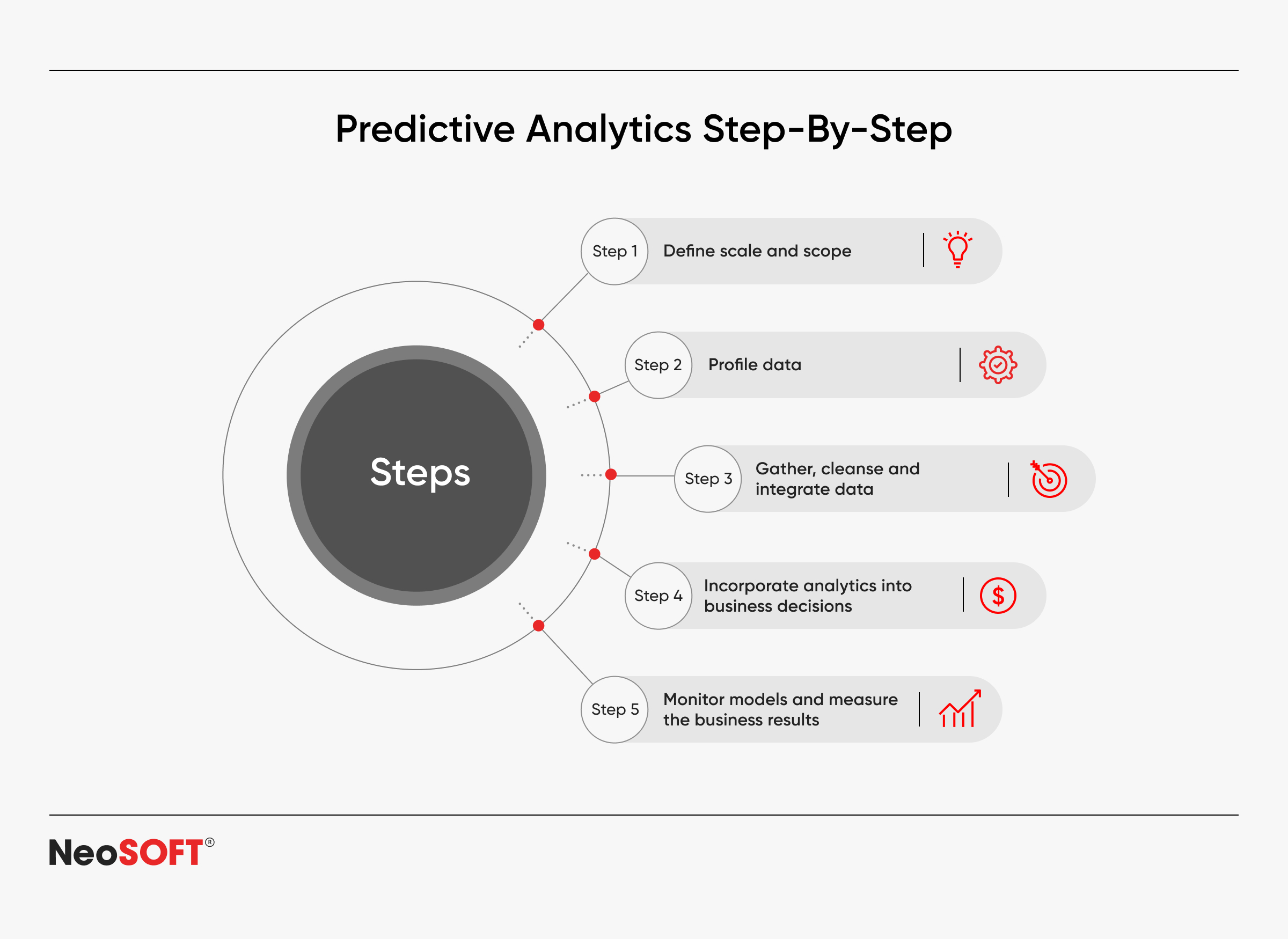
Predictive Analytics in Risk Management: a Walkthrough
Predictive analytics findings require careful planning in order to be accurate, reliable, and beneficial to risk management. Here are the essential actions to take:
Data Collection
Data forms the basis of every predictive analytics model. To feed relevant datasets into the predictive models, financial institutions must compile and arrange them. This includes:
Historical financial data – Credit reports, transaction history, loan performance, and market data.
External data sources – Real-time market conditions, industry trends, and economic statistics.
Behavioral data – Consumer communications, internet habits, and purchasing trends. The data’s completeness, consistency, and quality are essential for developing dependable predictive models.
Model Building
The next stage after data collection is to create prediction models that are customized to different financial risk scenarios. Key considerations for this part of the process include:
Choosing the right algorithms – Risks like fraud, credit default, and market downturns can be predicted using models developed using ML approaches (e.g., decision trees, neural networks, or regression analyses).
Feature engineering – Determining which characteristics or variables are most important in influencing the goal risk. As an example, numerous factors about a borrower’s financial profile, like their income, level of debt, and transaction history, could all be considered in the credit scoring process.
Training the model – To train the model and teach it to learn from previously seen trends and patterns, past data is fed into the algorithm.
It is necessary to confirm the model’s accuracy and dependability prior to deployment, which includes:
Testing with new data – Assessing the model’s predictive ability by applying it to unknown or out-of-sample data.
Cross-validation – Dividing the dataset into several subgroups in order to reduce overfitting and test the model on various areas.
Model tuning – Optimizing the model’s predictions by retraining it using performance measurements (such as accuracy, precision, and recall) and adjusting its parameters.
Integration with Existing Systems
The model needs to be included in the financial institution’s current risk management system after it has been validated. This calls for:
Connecting with current systems – Ensuring that the decision-making tools, risk management systems, and databases currently in use are all compatible with the predictive model.
Real-time data flow – Establishing pipelines to guarantee data inputs into the model in real-time or almost real-time for ongoing surveillance and risk assessment.
User interfaces – Designing user-friendly dashboards or reporting tools that enable risk managers to swiftly obtain information and make wise decisions depending on the model’s results.
Common Challenges and Potential Solutions
Depending on historical data that might not always take into account new developments or market movements, is one of the main obstacles to applying predictive analytics to financial risk management. Poor data quality – such as partial or skewed data – can result in forecasts that are not correct. Another concern is model overfitting, in which algorithms work well on data used for training but poorly on fresh data. Last but not least, there are ethical worries about confidentiality of data and the possible abuse of private or sensitive data.
Here are a few ways to avoid or solve these challenges:
Diversify Sources of Data – Incorporate external and real-time data to take into consideration unforeseen circumstances and new trends.
Quality Control – To guarantee data correctness and completeness, put strict cleaning and validation procedures into place.
Regular Updates – Regularly reviewed and update predictive models to reflect changing circumstances.
Cross-Validation – Make sure algorithms can generalize to new and unknown data through stress testing and cross-validation.
Ethical Compliance – To safeguard sensitive data, follow stringent data privacy laws and use moral AI techniques.
Conclusion
The way financial businesses manage risk and protect their operations has changed dramatically as a result of predictive analytics. Predictive analytics is transforming risk management tactics in the finance and banking sectors by helping companies foresee possible security breaches, make informed choices, and lower their chance of incurring losses.
Predictive analytics has proven very helpful to businesses across all industries, as this blog indicates, but it is only effective if the companies have the resources and technological know-how to make the most of it.
We at NeoSOFT can offer you exactly that expertise. Allow us to help you implement custom predictive analytics technologies and completely transform your financial risk management system. Reach out to us today at info@neosofttech.com to learn more about our expert services and how we can assist you in leveling up your risk management strategies.
We use cookies on our website to give you the most relevant experience by remembering your preferences and repeat visits. By clicking “Accept All”, you consent to the use of ALL the cookies. However, you may visit "Cookie Settings" to provide a controlled consent.
This website uses cookies to improve your experience while you navigate through the website. Out of these, the cookies that are categorized as necessary are stored on your browser as they are essential for the working of basic functionalities of the website. We also use third-party cookies that help us analyze and understand how you use this website. These cookies will be stored in your browser only with your consent. You also have the option to opt-out of these cookies. But opting out of some of these cookies may affect your browsing experience.
Necessary cookies are absolutely essential for the website to function properly. These cookies ensure basic functionalities and security features of the website, anonymously.
Cookie
Duration
Description
cookielawinfo-checkbox-analytics
11 months
This cookie is set by GDPR Cookie Consent plugin. The cookie is used to store the user consent for the cookies in the category "Analytics".
cookielawinfo-checkbox-functional
11 months
The cookie is set by GDPR cookie consent to record the user consent for the cookies in the category "Functional".
cookielawinfo-checkbox-necessary
11 months
This cookie is set by GDPR Cookie Consent plugin. The cookies is used to store the user consent for the cookies in the category "Necessary".
cookielawinfo-checkbox-others
11 months
This cookie is set by GDPR Cookie Consent plugin. The cookie is used to store the user consent for the cookies in the category "Other.
cookielawinfo-checkbox-performance
11 months
This cookie is set by GDPR Cookie Consent plugin. The cookie is used to store the user consent for the cookies in the category "Performance".
viewed_cookie_policy
11 months
The cookie is set by the GDPR Cookie Consent plugin and is used to store whether or not user has consented to the use of cookies. It does not store any personal data.
Functional cookies help to perform certain functionalities like sharing the content of the website on social media platforms, collect feedbacks, and other third-party features.
Performance cookies are used to understand and analyze the key performance indexes of the website which helps in delivering a better user experience for the visitors.
Analytical cookies are used to understand how visitors interact with the website. These cookies help provide information on metrics the number of visitors, bounce rate, traffic source, etc.
Advertisement cookies are used to provide visitors with relevant ads and marketing campaigns. These cookies track visitors across websites and collect information to provide customized ads.