There is a useful way to track the ambitions of a global enterprise: look at what it builds in India, and look at what it asks that team to own.
A decade ago, the answer was back-office operations, IT support, and cost-driven processing. Today, the answer is product roadmaps, AI platforms, cybersecurity mandates, and end-to-end ownership of global business outcomes. That shift — from support function to strategic nerve center — is the defining story of India’s Global Capability Center ecosystem in 2026, and it has profound implications for every CXO building an enterprise that competes without borders.
The Numbers Tell Only Part of the Story
India now hosts over 2,100 Global Capability Centers, employing more than 2.3 million professionals and contributing close to $65 billion annually to the global enterprise technology economy. By 2030, projections point to a $100 billion market anchored by over 2,500 centers.
These figures matter, but they risk obscuring what is actually significant. Scale was never India’s distinguishing advantage — it was merely the entry point. What has changed is the nature of the mandate. According to EY’s GCC Pulse Report 2025, 92% of GCC leaders confirm that their centers now contribute far beyond cost arbitrage. Eighty-seven percent report end-to-end ownership of global processes. Forty-five percent participate directly in global strategic decision-making.
The borderless enterprise is not a metaphor. It is an operating model — and India’s GCCs are increasingly the place where it is being designed, built, and run.
From Cost Arbitrage to Innovation Arbitrage
The language of GCC strategy has changed meaningfully. CXOs who once justified India investments with labor cost ratios now speak in the vocabulary of innovation arbitrage: the idea that India’s unique combination of STEM depth, ecosystem maturity, and entrepreneurial energy makes it the best place in the world to not just execute innovation, but to accelerate it.
This transition is not abstract. It is visible in the portfolios GCCs now own. GenAI adoption has reached 83% across India’s GCC ecosystem, with applications concentrated in high-value domains — customer intelligence, financial modeling, IT operations, and cybersecurity. Agentic AI investment is accelerating: 58% of GCCs are already investing in autonomous AI systems, with a further 29% planning to within the year.
Beyond AI, GCCs are driving product engineering programs, managing global cloud infrastructure, building Centers of Excellence in data science and cybersecurity, and leading enterprise-wide automation initiatives. A Fortune 100 retailer’s Bengaluru GCC developed an AI-powered supply chain visibility platform that improved inventory forecasting accuracy by 35% and materially reduced last-mile delivery costs — within a single fiscal year. These are not support outcomes. They are strategic outcomes, built in India and deployed globally.
The Talent Flywheel
The engine behind this transformation is talent — not just in volume, but in quality, continuity, and leadership depth.
India produces over 3 million STEM graduates annually. But raw supply is only part of the story. What has changed in the most mature GCCs is the investment in career architecture: reskilling programs now operating at 71% across the ecosystem, internal mobility frameworks that have meaningfully improved retention, and leadership development initiatives designed to grow GCC heads who carry dual mandates — running India operations while leading global portfolios in product, engineering, or data.
The attrition story is one of the more underreported GCC successes of recent years. Sector-wide attrition has declined from 13% in 2023 to 9% in 2025, driven by upskilling access, flexibility, and genuine career mobility rather than compensation alone. GCCs that invest in purpose-driven talent development — giving engineers and product managers real ownership of globally consequential work — are building retention that no compensation package can easily replicate.
The remaining challenge is leadership localization. Nearly 80% of GCCs still have less than 10% of their leadership roles based in India. For organizations serious about innovation arbitrage, this is the next frontier: building India-based leaders who shape global strategy, not just implement it.
The Architecture of a Borderless Enterprise
Building a GCC that genuinely functions as a global innovation engine requires more than hiring decisions and office leases. It requires architectural clarity on several dimensions simultaneously.
Governance and integration determine whether the GCC operates as an extension of headquarters or a satellite. The center delivers strategic value, has clear reporting structures, and shared KPI with business outcomes. Regular cadences between the GCC leadership and global decision-makers are also required.
Technology infrastructure requirements are necessary as AI moves to enterprise-scale workloads. Data governance frameworks and cybersecurity posters that protect intellectual property are needed. This creates less friction, and centers can take on high-value tasks.
Choosing the right operating model for their maturity and strategic intent can achieve faster time-to-value and lower transition risk than those that use more familiar structures.
What the Next Wave Looks Like
The GCCs that will define the next decade are not being built to do what their predecessors did more cheaply. They are being built to do things that were never possible before: deploy Agentic AI at enterprise scale, own global product development end-to-end, and translate India’s depth of engineering talent into intellectual property that shapes markets worldwide.
The geographic footprint is also expanding. Tier-2 cities — Coimbatore, Jaipur, Visakhapatnam, Indore — are emerging as credible GCC hubs, offering talent depth, lower operating costs, and government-backed incentive structures that make the economics of innovation even more compelling.
The borderless enterprise is not coming. It is already here. And its digital engine is running, increasingly, from India.
Engineering the GCC Advantage
For global enterprises at any stage of their GCC journey – from initial strategy to scaled operations – NeoSOFT brings the engineering depth, domain expertise, and delivery experience to make the ambition real.
With over two decades of enterprise technology delivery across 20+ industries and 5,000+ projects globally, NeoSOFT has partnered with organizations building GCCs that go beyond cost savings to become genuine centers of innovation. From technology infrastructure design and AI platform engineering to talent capability building and governance frameworks, NeoSOFT brings the integrated expertise that transforms a GCC from a concept into a competitive advantage.
Building a borderless enterprise starts with building it right. NeoSOFT is the partner that helps enterprises do exactly that.
Unified Commerce in the high-stakes retailing world of 2026 is the security blanket of choice for companies. Applications that support Click and Collect functions are used to showcase the enterprise ecosystem. Yet, a shocking fact persists: despite most big companies providing the function, a 2026 benchmark found that only 7% had mastered leadership, leaving 93% unable to even execute the concept properly.
However, the Click and Collect Test is not passed at the checkout screen; it is passed at the store floor level. If a customer comes in only to find that his order, which is supposed to be completed, is missing one item or, even worse, cancelled three hours after his confirmation email, the whole concept of unified commerce fails miserably. The year 2026 presents the biggest challenge: failing to deliver on promises.
1. The Phantom Inventory Epidemic: Why 99.9% is the New Minimum
The main problem retailers face when implementing Click and Collect is a breakdown in inventory integrity. Retailers continue to rely on an outdated system in which web applications and POS systems are synchronised via a batch process rather than in real time, at sub-second intervals.
The 95% Accuracy Trap
In brick-and-mortar stores, 95% inventory-tracking accuracy was considered best-in-class. In the realm of unified commerce, 95% accuracy equates to a strategic blunder. If there are 100 units of a popular product in stock and 5 units are ghosts (lost or stolen products), it is mathematically certain that a Click and Collect customer will be offered an imaginary product at some point in time.
The Financial Fallout: Global logistics and fulfilment costs have risen by over 20% in the last three years. Every cancelled order isn’t just a lost sale; it’s a sunk cost of labour and customer acquisition.
Cancellation notifications are a critical threat: research indicates 60% of shoppers will defect from a brand after a single Click and Collect failure.
Key Takeaway: Real-time inventory visibility and dynamic allocation are now essential for retailers to execute Click and Collect successfully and remain competitive in 2026.
2. The Labour Friction: The Store as a Dark Warehouse
The second reason for failure is an operational mismatch. The vast majority of brick-and-mortar stores are built for browsing rather than picking. If Click and Collect is implemented without changes to the labour force structure, store personnel face the choice between serving customers at the counter and picking customer orders in their cars.
The Staging Logistics Crisis
Even if the inventory is accurate, the staging process is often a mess. Orders are often tucked behind service desks or in cramped break rooms.
Friction Point: Customer waits for more than 4 minutes for Instant pickup erodes the perceived convenience benefit.
The 2026 Solution: High-performing retailers are implementing Micro-Fulfilment Zones within the store dedicated speed lanes and automated lockers that bypass the service desk entirely. The key takeaway: separating Discovery Space from Logistics Space streamlines store operations and improves customer experience.
3. The Appearance Gap: The $850 Billion Returns Problem
Data from 2026 reveals a secret flaw within Click & Collect: The Physics of Representation. A considerable number of Collect transactions are denied at the checkout counter when the actual item does not match its visual representation on the screen.
The Reject at Counter Phenomenon
Visual mismatch is something retailers do not take into account when standardising digital content. The moment someone from Dubai buys a luxurious silk scarf that appears to be of a different shade due to poor lighting, then the entire deal becomes void.
The Insight: With retail returns reaching nearly $850 billion annually, a Click and Collect order rejected at the counter is the most expensive type of return because it consumes store labour twice once for the pick and once for the restock.
Key Takeaway: Accurate digital representation of products and alignment with in-store experiences through advanced technologies are crucial to avoiding expensive Click and Collect returns.
4. The Retail Media Miss: The Unmonetized Foot Traffic
It is quite ironic that retailers are failing to capitalise on the revenue stream. Click and Collect is not only about saving on delivery costs but also about bringing the consumer into the ecosystem where they are likely to be impacted by In-Store Retail Media.
The Last-Yard Monetisation Gap
At the point of order pickup, customer purchase intent peaks. However, 90% of retailers fail to capitalize on this pivotal opportunity with context-driven upsells, missing out on tangible incremental sales.
The Miss: A customer picks up a new smartphone but isn’t served a digital At-Shelf offer for a screen protector via their app.
Agentic Personalisation: If the retailer’s system is truly unified, the pickup notification should trigger a personalised, limited-time offer visible only while the customer is within the store’s geofenced radius. This N=1 strategy is proven to unlock billions in value globally by turning a functional pickup into a discovery session.
5. Regional Nuances: India vs GCC Execution
The Click and Collect failure looks different depending on the geography:
In India, this problem is termed Last-Mile Hybridisation. The reason for most failures is congestion gap, which means that although the store can be reached, the collection point cannot. The success stories have been achieved through WhatsApp-driven curbside coordination.
In the GCC, however, the problem arises at luxury service levels, where Click & Collect from an expensive mall should be considered VIP treatment. A lack of dedicated, luxurious lounges for digital collections lowers service levels for wealthy people.
Conclusion: The Era of Precise Execution
It is not enough to imagine Unified Commerce as a technical concept; it must be implemented to be realised. Retailers that will rule 2026 and 2027 are those who understand that when you click Buy, you are making a promise to deliver results. Unless you can deliver the goods in-store, pack them in a bag, and drop them in a locker, you are not unified; you are omnichannel.
We at NeoSOFT create Unified Data Foundations that enable real-time ERP integrations and AI-powered workforce optimisation. This approach turns the Click and Collect fallacy into a profitable reality by seamlessly blending the digital and physical worlds.
Did you know that future bank branches may not exist as physical buildings? The banking sector is undergoing a massive shift right now. Simple mobile apps are no longer enough for modern tech users. Customers expect intelligent, instant, and personalized financial solutions every single day.
Traditional institutions must embrace digital banking transformation to remain relevant today. Future banks will build their entire operations around advanced deep tech tools. Five emerging technologies are poised to re-architect modern finance by 2035.
Five Core Technologies Re-Architecting the Future of Banking
Traditional computers require long overnight processing to run complex market risk calculations. Quantum computing processes millions of fluctuating market variables in just seconds.
Financial institutions use this power for instant credit scoring and risk evaluation. Automated systems will create personalized investment plans tailored to your specific budget. Cloud computing solutions help secure this computing power for global institutional networks.
Quantum algorithms evaluate risks immediately to protect businesses during unexpected market drops. Institutions are also upgrading encryption models to prevent dangerous quantum cyberattacks.
Key Takeaway: Quantum tools turn slow data checks into instant predictive risk decisions.
2. Artificial Intelligence Powers Smart Bank Systems
Artificial intelligence in banking goes far beyond simple customer support chatbots. Advanced AI platforms act as intelligent financial advisors for millions of customers.
Smart systems analyze transaction patterns to spot fraudulent activity within milliseconds. Autonomous agents handle trade settlements without requiring slow manual paper reviews.
Predictive AI models offer customized wealth management advice directly to retail clients. Using intelligent fintech solutions cuts operating costs while delivering great user experiences.
Decentralized finance relies on blockchain technology in finance to transfer assets safely. Distributed networks allow peer-to-peer transfers without requiring expensive middleman clearing steps.
Regulated stablecoins and crypto assets enable instant cross-border payments all day long. Transparent blockchain rails lower transaction fees for everyday international money transfers.
Low operational costs help financial tools reach unbanked communities across the globe. Modern banks now integrate public ledgers straight into their core platforms.
Key Takeaway: Blockchain rails deliver low-cost payments and global liquidity without delays.
4. Embedded Finance Makes Banking Ambient Everywhere
Customers rarely want to open a dedicated banking app for payments. Embedded finance platforms put financial products directly inside everyday consumer applications.
You can apply for real-time micro-loans right inside e-commerce shopping carts. Connected smart cars automatically pay for tolls and charging during your commute.
Banks use secure open banking APIs to connect services with external software. This ambient approach brings financial assistance to the exact moment of need.
Key Takeaway: Embedded finance turns banking into a convenient invisible layer inside software.
5. Invisible Biometrics Provide Passwordless Security Systems
Traditional passwords and text security codes are becoming risky security options. Biometric authentication technology uses facial structures, voice prints, and behavior patterns.
Your physical identity replaces long login details across all your digital accounts. Smart systems monitor logins continuously to stop identity theft before it happens.
Customers can safely handle account transfers using simple natural voice commands. Cybersecurity in banking improves when passwords disappear from active security protocols.
Key Takeaway: Biometrics removes user friction while building strong zero-trust identity security.
Industry Research and Key Evidence
Leading industry studies show that adopting artificial intelligence in banking can unlock over $1 trillion annually for global banks. World Bank statistics highlight that about 24% of adults lack standard bank accounts.
Lowering cost barriers using fintech digital innovation helps include these underserved populations. Moving legacy systems onto cloud platforms is essential for operational growth. Technology engineering partners like NeoSOFT help financial institutions modernize old core platforms into cloud-native microservices.
Conclusion
Future financial success will not depend on physical branch office footprints. The winning banks of 2035 will combine quantum speed, smart AI, and biometric security. Rebuilding legacy core platforms demands strong enterprise digital transformation foundations today. Modern financial institutions must upgrade systems now to remain competitive and deliver seamless customer experiences.
Future-proof your financial institution and accelerate your modern banking transformation journey with NeoSOFT. Connect with our expert digital engineering team today to build scalable cloud, AI, and API solutions.
In the high-stakes digital boardrooms of 2026, a fundamental shift has occurred. The customer is no longer just the human scrolling through a mobile feed; it is increasingly a high-speed AI agent. We have officially moved beyond the era of automated marketing into Agentic Commerce, a world where autonomous systems mediate the journey from discovery to checkout.
For retail and e-commerce leaders, 2026 is the year of Sovereignty. As Retail Media Networks (RMNs) evolve into the operating systems of commerce, the brands that win are those that prioritise machine-legibility as much as human appeal.
The Rise of the Machine Buyer: Understanding Agentic Commerce
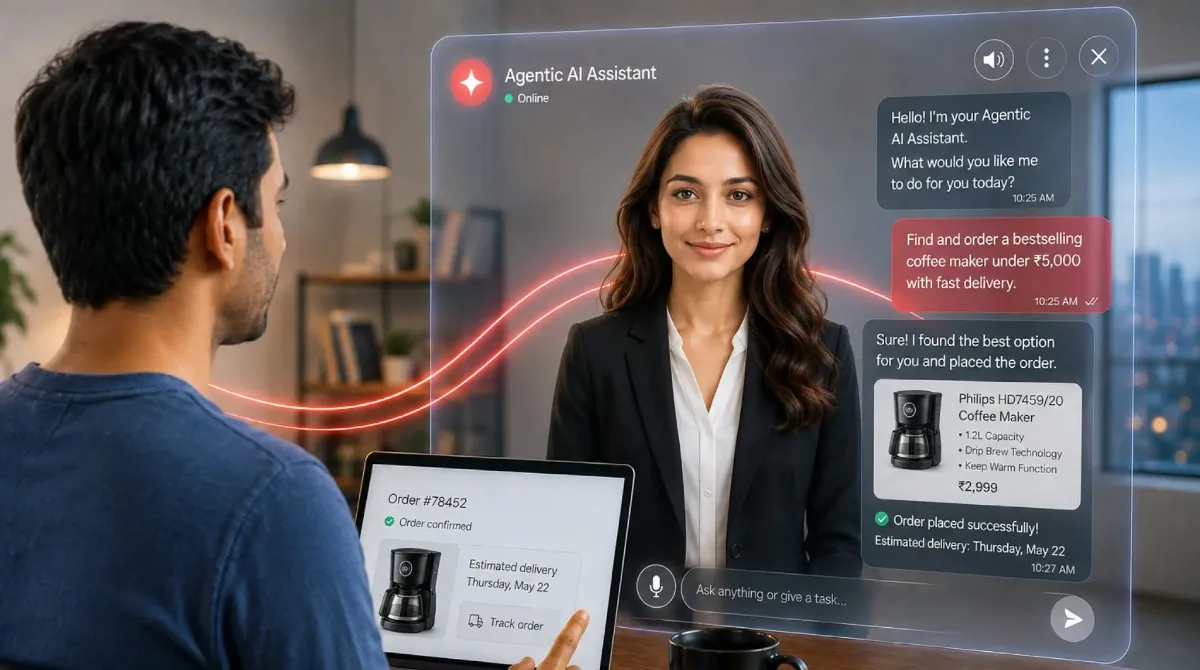
The most disruptive trend of 2026 is the emergence of Delegated Shopping. Consumers now set high-level intent Find a durable, eco-friendly coffee maker under $200 for my office and their personal AI agent handles the research, price comparison, and execution.
According to recent NRF 2026 analysis of agentic commerce trends, retailers are shifting from if to how in implementing agentic strategies. At NRF 2026, nearly 75% of attendees reported they were either currently implementing or actively planning agentic initiatives.
The Challenge: Traditional search ads and persuasive copy are secondary to an AI agent. These systems optimize for clarity, delivery certainty, and structured data. If your product information is ambiguous or your delivery terms are not machine-readable, you are invisible to the agent.
Trend 1: Agent Legibility and Universal Protocols
In 2026, the new SEO is Agent Legibility. Retailers are shifting toward standardised frameworks such as the Universal Commerce Protocol (UCP) to ensure their back-end data is accessible to independent buyers.
Structured Metadata: High-fidelity data on real-time inventory, shipping cut-offs, and return eligibility is now a mandatory ad asset.
API-First Commerce: To be selectable, your retail media stack must expose real-time signals to AI agents. Bidding is no longer just about keywords; it’s about providing a Verified Consent pathway for agents to complete purchases securely.
By 2026, nearly 60% of enterprise applications will be powered by agentic AI. Brands that fail to modernise their data foundations are effectively paying a legacy tax as agents default to competitors with cleaner, more structured data.
Trend 2: Zero-Click Shopping and Ambient Discovery
The interface is disappearing. We have entered the era of Zero-Click Shopping, where the Search-and-Browse model is replaced by Contextual Triggers.
Invisible UX: Through IoT and ambient smart-home sensors, retail media has moved into the background. A smart appliance detects a need and initiates a purchase request via a retail media trigger, requiring only a simple biometric confirmation from the user.
Mission-Based Ads: Instead of showing a product, retail media now offers a Mission Resolution. If a user tells their wearable, I’m going on a mountain hike tomorrow, the retail media engine assembles a curated Hike Pack from sponsored brands, ready for same-day delivery.
This shift toward zero-click buying in 2026 means people can purchase products without ever clicking a buy button or leaving their primary app interface.
Trend 3: From ROAS to iROAS (Incremental ROI)
The industry has finally exposed the ROAS Lie. In 2026, sophisticated CMOs have pivoted to Incremental Return on Ad Spend (iROAS).
The Shift: Traditional ROAS often took credit for lazy sales loyalists who were already going to buy organically. Performance Marketing 2.0 uses Predictive ROI Simulation to measure true incrementality.
Margin-Aware Bidding: AI now automatically throttles spend on low-margin SKUs or regions with high shipping friction.
Predictive Optimisation: Instead of analysing trailing data, brands run Monte Carlo simulations to forecast campaign success before a single dollar is spent.
Trend 4: Unified Phygital Ecosystems
The store is no longer just a physical location; it is a High-Intent Sensor. In the Middle East and India markets, Unified Commerce is the baseline.
Store-Mode Experiences: Retailer apps now switch to Store Mode the moment a customer walks in, using AR-enabled navigation and real-time mobile triggers to bridge the online and offline experience.
In-Store Media Auctions: Digital signage and smart end-caps are now part of the programmatic retail media auction, allowing brands to bid for a customer’s attention at the exact moment they reach for a shelf.
As outlined in the US Tech Forecast 2026 for Retail, retailers are increasing tech budgets to $113 billion, with a significant portion dedicated to AI-enabled systems that improve in-store technology and self-service experiences.
The NeoSOFT Edge: Engineering the Race of the Progressive
The transition to an agentic, zero-click economy is not a simple software update it is a total architectural overhaul. At NeoSOFT, we act as the architects of this evolution.
We help global brands build the Digital Transformation Frameworks required to thrive in the 2026 landscape. From implementing Universal Commerce Protocols to deploying Predictive ROI Engines, we ensure your retail media infrastructure is built for scaled intelligence. Whether it’s neutralising logistics friction or automating Agentic Commerce journeys, NeoSOFT is the partner for leaders who demand more than just automation. We don’t just help you follow the trends; we help you set the pace of progress.
The agentic commerce era is here is your retail infrastructure ready? Explore how NeoSOFT is helping global brands build for zero-click shopping, predictive ROI, and AI-native commerce. Explore more insightful blogs here.
FAQs
1. How does Agentic Commerce change my retail media bidding?
It shifts the focus from human attention to System Selection. You are bidding to have your structured data prioritised by an AI agent’s selection algorithm.
2. What is Zero-Click shopping?
A frictionless model where AI agents initiate purchases based on contextual triggers (like IoT sensors), requiring minimal human interaction.
3. Why is iROAS becoming the standard metric?
It measures True Incrementality, filtering out organic sales that would have happened anyway to show the actual value of ad spend.
4. Can small retailers compete in an Agentic era?
Yes. By adopting standardized protocols, even mid-market brands can make their data agent-ready, enabling them to compete on clarity and execution speed.
5. How does NeoSOFT solve Retail Media fragmentation?
We build Unified Intelligence Layers that consolidate disparate RMN data into a single source of truth for cross-platform optimisation.
Today’s shoppers won’t wait five seconds for a slow website to load, nor will they tolerate inaccurate store stock. Yet, thousands of traditional retail stores are trying to survive using computer systems built over a decade ago. Waiting to update store technology was a very big mistake today. Now these slow retail brands are losing money every single day.
When physical stores fail to sync real-time inventory with digital channels, customer trust disappears instantly. Legacy software simply cannot support the fast, connected experiences modern buyers demand. Upgrading your digital core is no longer just a technical choice, it is the baseline for business survival in today’s market.
The High Cost of Using Very Old Systems
Outdated retail platforms are hard to update and repair quickly. Rigid software acts like a heavy anchor on company growth. When digital updates are delayed, modern shoppers quickly leave your brand. Today’s buyers expect fast service and a seamless checkout process. Ignoring modern cloud tools leads to frequent and costly system errors.
Slow websites often crash during high-traffic holiday sales events. Outdated computer platforms fail to create smooth, multi-channel shopping experiences. Meanwhile, industry leaders use artificial intelligence to personalize every purchase. Retailers stuck with old systems remain blind to real customer needs. As a result, they lose track of what shoppers actually want to buy.
Building Fast Systems for Modern Retail Markets
Smart retail brands build powerful digital ecosystems to stay ahead. Flexible cloud platforms allow stores to scale and expand very quickly. Moving away from legacy systems gives your business true operational freedom. Using modern headless commerce technology makes online shopping exceptionally fast. Teams can update website designs without risking system crashes.
Smart computer algorithms help managers track inventory much better. Predictive software tells teams exactly how much stock to order each month. This stops stores from wasting capital on unsold products. Scalable software tools give your retail business a clear competitive advantage. Modern technology is essential for long-term survival and profitability.
Connecting Online and Offline Shopping for All Customers
Today’s buyers expect smooth shopping across every single sales channel. A customer might browse items on phones before visiting physical stores. They often prefer picking up online orders inside local retail shops. Legacy technology keeps crucial business data trapped in separate isolated places. A high-performance digital ecosystem connects every sales point into one view.
Mobile enterprise tools help store employees serve customers much faster. Smart tracking sensors monitor every single item inside your warehouse. Unified retail platforms build lasting trust with every new customer. Satisfied shoppers naturally return to buy from your brand again. Over time, happy customers significantly increase your overall Customer Lifetime Value (CLV).
Future-Proofing Your Retail Strategy for Long-Term Success
The era of relying on slow, outdated retail tools is over. Every enterprise brand must adopt a fast, modern digital system to remain relevant. You must stop paying the price for holding onto legacy technology. Digital transformation offers the clearest path toward sustainable growth and market leadership. Modern technology partners like NeoSOFT can help your business build a system designed to scale.
There is a quiet crisis unfolding in boardrooms across Dubai, Riyadh, Abu Dhabi, and Doha. It does not appear on balance sheets — but it is costing the region’s financial institutions billions in unrealised potential every year.
A staggering 96% of organisations globally report little to no efficiency or innovation gains from their AI investments, despite spending at a historic pace. In BFSI, where the promise of AI in finance is greatest, the gap between investment and return has never been wider.
For CXOs leading banks, insurers, and financial services firms across the Middle East, this is not a cautionary tale from distant markets. It is a live, urgent challenge — and a defining strategic opportunity.
The Middle East’s AI Moment — And Why It Cannot Be Wasted
The market, currently valued at approximately $15 billion in 2025, is projected to exhibit a robust growth rate of 25% from 2025 to 2033.
Saudi Vision 2030 and the UAE National AI Strategy 2031 have committed over $100 billion to technology infrastructure. BFSI claimed the largest share of the region’s digital transformation market in 2025, driven by banking modernisation and Islamic finance digitalisation. Middle Eastern banks have tripled their AI budget allocation since 2023 — focusing on ai in cyber security, AML, and customer intelligence. But as the Gartner report on AI confirms, Generative AI has entered the Trough of Disillusionment. Intent without the right engineering foundation is where transformation programmes stall.
Why Most AI Programmes Fail — And What BFSI Leaders Must Do Differently
Organizations fail at AI in finance because of three repeat issues: fragmented data, last-mile breakdowns, and a talent gap. The lesson is clear: strategy without architecture is just an expense. For this, institutions win when artificial intelligence is rebuilding the core – cloud-native, API first, data-unified embedding AI from the ground up.
Organisations fail at ai in finance not because the technology is flawed, but because three failures repeat: fragmented data (57% of organisations admit their data is not AI-ready), last-mile breakdowns where AI tools are deployed without re-engineering underlying workflows, and a growing talent gap — AI specialist wage inflation in the region now exceeds 20%. For AI for business leaders, the lesson is clear: strategy without architecture is just an expense.
The institutions winning with artificial intelligence in BFSI are rebuilding the core — cloud-native, API-first, data-unified — and embedding AI from the ground up. This means real-time fraud detection, BFSI AI segmentation across customer and risk layers, Arabic-language NLP for personalised engagement, AI for software development to accelerate delivery, and AI-native security operations for AI in cybersecurity compliance under CBUAE and SAMA frameworks.
NeoSOFT has over 25+ years of engineering excellence and CMMI level 5 certification, delivering outcomes and not experiments. All of our systems are designed for scale. And for organizations in the Middle East, our team of experts helps you every step of the way.
Frequently Asked Questions
1. What is the biggest mistake BFSI leaders make when deploying AI?
Implementing AI without a clean data foundation – ungoverned data produces unreliable outputs regardless of how advanced AI is. Organizations must prioritize data unification and governance before an AI initiative.
2. What does the Gartner report on AI say about the current state of adoption?
Earlier organizations implemented AI without a strategy. Today it is a structured, outcome-driven approach and hold advantage over those who moved fast without strong foundations.
3. What are the highest-impact AI use cases for Middle East BFSI?
AI in cybersecurity and AML, Arabic language personalisation, predictive risk management, and regulatory compliance aligned with regulatory frameworks.
4. How should a CXO evaluate an AI engineering partner?
Look for domain depth in financial services, CMMI-certified delivery rigour, and co creation model that transfers capability. Evidence of outcomes matters more than client logos.
Most corporate boards in 2026 share a common delusion: they believe a digitized business is a smart business. While billions have been funneled into cloud migrations and RPA bots, the result is often just faster versions of old, inefficient processes. You haven’t evolved; you’ve simply paved the cow path.
The Digital Sophistication Trap
If your automated supply chain still requires a human to manage a weather delay, or your CRM sends discount codes to a customer filing a formal complaint, you aren’t intelligent you’re just fast at being stupid.
Checking the Digital Transformation Achieved box on a quarterly report is easy. Anyone with a credit card can automate a process via a SaaS subscription. The hard truth of the mid-2020s is that true intelligence requires the capacity to synthesize information, predict uncertainty, and execute decisions at scale.
Act I: The Dumb Automation Ceiling
The first digital transformation was based on Deterministic Logic: If X happens, do Y. This was appropriate when the world was predictable. In the post-2025 economy of Permanent Volatility, however, this approach is now a liability.
The Fragility of Robotic Process Automation (RPA)
The old way of automating is brittle. It’s based on rules. So if the invoice changes by 5%, the bot breaks. If the customer’s sentiment changes from curious to frustrated, the automated email series continues to annoy the customer with more and more sales pitches – and actually destroys brand equity.
To get beyond this barrier, we need to think about Cognitive Orchestration. This is not just about replacing the human. It’s about replacing the logic that the human was executing. Instead of a script, we need a Reasoning Engine.
The NeoSOFT Strategic Pivot: We are enabling businesses to move from static scripts to Agentic AI Frameworks. These are not systems that trigger an action, but ones that read the intent of the data. When an intelligent system identifies a 10% price increase from a supplier, it is not just executing an invoice, it is cross-checking the contract, the market rate, and signaling the opportunity for strategic negotiation.
Act II: Context is the Only Competitive Moat
If data is the new oil, then Context is the refinery. Most businesses are swimming in an ocean of Crude Data – petabytes of data that inform them of what is happening, but never why it is happening. An automated business reports sales are down. An intelligent business reports sales are down because of a social media campaign run by our competitor, which impacted our Gen-Alpha consumer in the Pacific Northwest.
Building the Corporate Hippocampus
To make it intelligent, your organization needs a memory system that is centralized. This is the Neural Knowledge Graph. This is the step from Data Lakes to Contextual Fabrics.
The Technical Layer: Using Vector Databases and Graph Neural Networks, your organization can connect disparate data streams such as customer support tickets, weather data, social media data, and ERP data into one Truth Layer.
The ROI of Meaning: Once your AI system understands the relationship between these data streams, it moves from Predictive to Prescriptive analytics. It no longer just tells you what might happen. It tells you exactly what to do.
This kind of structural intelligence requires more than a plug and play solution for AI. It requires Advanced Data Engineering and Analytics so that your AI isn’t hallucinating from a patchwork of silos, but instead, it’s making decisions based on a corporate consciousness.
Act III: The Zero-Ops Future and the Invisible Enterprise
The end state of an intelligent transformation is Zero Ops. In a Zero Ops state, the boring parts of your business, the scaling of servers, the balancing of inventory levels, the handling of low-level support requests, all happen in the background.
Autonomous Decision-Making vs. Human-in-the-Loop
In an automated business, humans are the bottleneck. They are the ones that must Approve or Deny. In an intelligent business, humans are the Policy Architects. The Evolution: You set the ethical Guardrails and financial Reward Functions. The AI makes its way through the thousands of micro-decisions that get you there.
The Result: Your team stops fighting fires and starts designing better matches. This is the highest ROI of any AI investment. As noted in the McKinsey report on the Economic Potential of Generative AI, it’s not about the AI generating poems. It’s about the AI re-architecting the 2.1 billion hours of logic-based work which defines global commerce.
The Verdict: The Intelligence Audit
If you want to know where your business is in terms of Intelligent Enterprise, ask yourself one simple question: If my market changed by 20% tomorrow morning, would my systems automatically adjust to that change, or would I have to call a meeting?
If you have to call a meeting, you are not Intelligent Enterprise – you are merely automated.
To become an Intelligent Enterprise, you are undergoing a deep tissue surgery of your current technology stack. It involves disassembling your current silos and rebuilding them with Predictive Logic as the foundation. We do not just digitize your mess over at NeoSOFT – we engineer your intelligence. We deliver the systems that allow you to stop reacting to the present and start owning the future.
Automation got you this far but intelligence will take you further. See how NeoSOFT is helping enterprises move from rule-based scripts to autonomous decision-making across BFSI, logistics, and beyond. Read our latest blogs here.
Frequently Asked Questions (FAQs)
1. We’ve already spent millions on RPA. Is that investment wasted?
Not at all. Think of RPA as the muscles in your organization. Intelligence (AI) is like the brain. Your RPA bots are still useful for execution, but need to be re-wired to receive commands from an AI Reasoning Engine instead of a script. This is often referred to as Intelligent Process Automation (IPA).
2. How does Intelligence actually impact my bottom line?
This effect is seen in Margin Expansion. Automation results in a small cost savings from speed. Intelligence generates revenue by identifying opportunities that humans are not aware of, like dynamic pricing, predicting churn before it occurs, and hyper-personalizing product bundles that increase Average Order Value (AOV) by 30%+.
3. What is a Reasoning Engine in a business context?
A reasoning engine is an LLM (Large Language Model) and your own data. It is different from a chatbot in that it can reason through a multi-step problem. For example: A shipment is stuck in the Suez Canal. Find three alternative suppliers, compare their shipping costs and carbon footprints, and draft an amendment to our current logistics contract.
4. Is Intelligent Transformation a security risk?
The danger is not the AI, but the danger is uncontrolled AI. Private LLMs and Data Governance Frameworks help you ensure that your ‘Intelligence’ remains your proprietary advantage and never leaks into the public training data sets.
5. Where do I start if my data is currently a mess?
You begin with Semantic Mapping. There is no need to fix all of your data at once. You can choose one ‘High Value Stream’ (for example, Customer Lifetime Value or Supply Chain Resiliency), and create intelligent systems around it. Then, when the ROI is proven, you can scale the intelligence horizontally throughout the enterprise.
The BFSI (Banking, Financial Services, and Insurance) sector has officially entered the era of Governed Intelligence. By 2026, the industry will have graduated from the Experimental AI phase, where pilot projects and simple chatbots dominated the boardroom conversation. Today, the focus has shifted to Agentic AI autonomous systems capable of perceiving intent, reasoning through complex regulatory constraints, and executing end-to-end financial workflows without human hand-offs.
However, as many institutions have discovered, simply adding AI is not a strategy. The leaders in 2026 are those who have solved the Implementation Gap: the space where sophisticated models fail because they are layered over stagnant legacy architecture. True digital transformation in BFSI now requires a complete reconstruction of how data flows, how decisions are explained, and how risk is managed in real time.
1. Beyond the Conversational Interface: The Rise of Zero-UI Agentic Banking
For the last decade, digital transformation focused on the Front-end Fallacy the belief that a better chatbot equals a better bank. In 2026, we realize that the best interface is often no interface at all.
The Strategic Shift: We are moving toward Zero-UI Banking. Instead of a user navigating five menus to check loan eligibility, Agentic Workflows operate in the background. These agents monitor Life Event Triggers such as a salary hike or a geo-location ping at a property exhibition to preemptively prepare a pre-approved mortgage offer.
The Economic Impact: An AI that talks is a tool; an AI that acts is a financial agent. By shifting from reactive bots to proactive agents, banks are seeing a 35-50% increase in Customer Lifetime Value (LTV) because the Time-to-Value for the user has been reduced to a single tap. The goal is Frictionless Sovereignty, where the bank anticipates the user’s needs before the user even articulates them.
2. Erasing the Sync-Lag: Event-Driven Data Mesh as the Heart of Finance
The greatest silent killer of AI ROI in BFSI is Sync-Lag. When an AI model relies on stale batch data from 24 hours ago, its intelligence is effectively obsolete. If a customer makes a large deposit at 9:00 AM, but the AI-driven wealth advisor suggests a low-balance savings plan at 11:00 AM, the brand’s Intelligence is exposed as a technical failure.
The Strategic Shift: Leading institutions are replacing centralized Data Lakes with an Event-Driven Data Mesh. This architecture allows AI to ingest live transaction streams (Real-Time Observability) as they occur.
The Insight: In a high-velocity market, data age is as important as data quality. Whether it’s detecting a sophisticated fraud pattern or offering a wealth management tip during a market dip, the AI must operate in the Now. Data Mesh ensures that the AI’s brain is perfectly synced with the bank’s ledger. This is the move from Reactive Analytics to Predictive Orchestration.
3. The End of the Black Box: Engineering Trust with Explainable AI (XAI)
As AI takes over high-stakes decisions like credit underwriting and insurance claims, the Accountability Gap has become a trillion-dollar regulatory risk.
The Strategic Shift: Under frameworks like RBI Master Directions and GCC Data Privacy Laws, The algorithm said so is no longer a valid legal defense. Enter Explainable AI (XAI). Instead of a binary Yes/No, banks are using Counterfactual Logic to provide transparent audit trails for every automated decision.
The Insight: Trust is the only currency that matters in BFSI. When a loan is denied, an XAI-powered app doesn’t just show a rejection; it provides a Path-to-Approval (e.g., Reduce your debt-to-income ratio by 8% to unlock this credit line). This transparency turns a negative experience into a financial roadmap, keeping the customer within the ecosystem rather than pushing them toward a competitor.
4. Operational Deflection: Automating the Un-automatable in the Middle Office
The highest ROI in 2026 isn’t found in flashy mobile features; it’s hidden in the boring middle office KYC renewals, trade reconciliation, and claims processing. This is where the highest Cost-to-Serve lives.
The Strategic Shift: Traditional RPA (Robotic Process Automation) was rigid and failed when it encountered Unstructured Data. Agentic RPA changes this by using Large Language Models to reason through exceptions. It can read a messy, handwritten insurance claim, cross-reference it with three different legacy databases, and flag only the specific anomalies for human review.
The Insight: We call this Operational Deflection. Success is no longer measured by Time Spent in App, but by the number of manual back-office hours eliminated. By 2026, Agentic AI has reduced manual KYC workloads by up to 70%, allowing human talent to focus on high-value advisory roles rather than data entry.
5. Regulatory Orchestration: Turning Compliance into a Competitive Advantage
Compliance has traditionally been viewed as a Cost Center a drag on innovation. In 2026, it became a data asset.
The Strategic Shift: By embedding Regulatory Orchestration directly into the AI backbone, banks are achieving Always-On Compliance. Systems like NHCX (for healthcare) and CIMS (for banking) are now monitored by AI agents that auto-fill filings and flag AML (Anti-Money Laundering) risks in real-time.
The Insight: Real-time compliance allows banks to operate with lower capital buffers because their risk visibility is 100% accurate. In a world of fluctuating interest rates and tightening capital requirements, this Capital Efficiency is a major competitive advantage that allows Intelligent Banks to out-lend their traditional peers.
6. Hyper-Personalization Loops: The Move from Offers to Fiduciary Guardrails.
Most personalization in banking is just high-tech spam. Users are tired of Next-Best-Offers for credit cards they don’t need.
The Strategic Shift: The role of AI is shifting from a Seller to a Fiduciary Bodyguard. Instead of pushing a product, the AI should identify a double-charge on a utility bill, suggest moving idle funds into a high-yield bucket, or alert the user to a recurring subscription they no longer use.
The Insight: When an app saves a user $50 without being asked, it earns more loyalty than a thousand reward points ever could. This is the Fiduciary AI Model, whose primary goal is to optimize the user’s net worth. This builds a defensive moat around the customer that competitors cannot easily penetrate.
7. Managing Model Drift: Scaling with Human-in-the-Loop Observability
The final, most critical role of AI in BFSI transformation is knowing when the machine needs a human. Financial markets are chaotic, and Black Swan events can cause even the best models to fail.
The Strategic Shift: Scaling AI without Model Observability is a recipe for disaster. Institutions are now implementing Active Learning Loops, in which human subject-matter experts serve as the Strategic Compass for the AI’s Computational Muscle.
The Insight: Model Drift the decay of AI accuracy over time is inevitable as market conditions shift. Digital transformation is not a Set and Forget project; it is a permanent partnership. The institutions that win are those that treat AI as an evolving organism that requires constant human-in-the-loop oversight to prevent Confident Hallucinations from hitting the balance sheet.
The Strategic Verdict: From Digitized to Intelligentized
Digital transformation in 2026 is no longer about moving paper to glass; it’s about moving logic to agents. The BFSI sector is shifting from being Digital-First to Intelligence-First. When AI moves out of the innovation lab and into the core ledger, it stops being a gimmick and starts being an engine. True transformation occurs when the AI is invisible, the data is real-time, and the decisions are explainable.
At NeoSOFT, we don’t just build apps; we orchestrate Digital Transformation Strategy. We help global financial leaders build the Agentic AI and Data Orchestration layers that define the 2026 banking landscape. Don’t just follow the trend lead the orchestration.
The year is 2026. A silent liquidation is taking place in the world market.
Not because of a sudden collapse or a lack of demand. Not because of anything remotely exciting. The silent liquidation is taking place because of a 0.5-second gap. That is the time it takes for an AI-Native enterprise to consume a market signal, adjust its entire supply chain, and outbid you on that lead before your middle management has even opened their first Zoom meeting of the day.
The vast majority of companies are celebrating today. They have integrated AI into their business. They have chatbots. They have Copilots. They are Using AI in their business. The truth is brutal. Using AI is like putting a rocket engine on a wooden raft. It looks impressive for a second before it tears itself asunder. The companies that will dominate the world in the coming decade are not using AI. They are Running on AI. They have fundamentally changed their DNA to move at the speed of silicon. The companies that are simply using AI are left to fight for scraps in a world that passed them by years ago.
Are you on the right side of the 0.5-second gap? Let’s take a look at the architectural difference between life and death.
1. The Bolt-On Mirage: Why Incremental AI is a Trap
Most companies are currently stuck in the Bolt-On phase. They are taking a legacy, people-centric process and simply adding AI on top of that. A person writes a prompt, a person reviews the results, and a person manually moves that result into another system.
The Problem: This produces Micro-Efficiencies and Macro-Silos. While an individual employee may save 20 minutes a day, the entire organization is still only moving at the speed of human bureaucracy.
The Solution: The transition to Agentic Workflows. In an AI-Native company, the AI is not a “tool” that is used by a human; it is an Autonomous Agent.
Using AI: A marketer uses ChatGPT to write an ad.
Running on AI: An Autonomous Agent is monitoring ad performance in real time, detects that conversions are down, adjusts the budget allocation to a more profitable segment, creates new creative assets all before breakfast.
For Run on AI to be possible, the underlying data architecture must evolve beyond its passive storage role to become an active Neural Nervous System. Data Lakes of the last decade are too slow to meet the real-time demands of the year 2026.
The Technical Shift: Vector Fabrics & RAG at Scale Advanced organizations are moving toward Vector Databases that integrate with a Real-Time Data Fabric. This enables Retrieval-Augmented Generation (RAG), where the AI model has immediate semantic access to all contracts, emails, and telemetry events in the company’s history.
Why it matters: If your AI has a memory instead of just a database, then it recognizes patterns that humans do not. It realizes that if there is a 2% delay in one of the raw material suppliers in Vietnam, there will be a corresponding 15% loss in revenue in the European retail sector three months down the line.
The NeoSOFT Edge: This Nervous System is enabled through High-Performance Data Engineering. Without a unified vectorized data layer, the AI is essentially hallucinating on incomplete data.
3. The Shift in Unit Economics: AI as a Fixed Cost
The greatest difference between Using and Running is seen on the Balance Sheet.
For a traditional company, growth means more people are required (Variable Labor Costs). For an AI-Native company, silicon does all the labor, and silicon scales easily. This moves the business model from Variable to Fixed. Once the AI models are trained and the agents are out, serving the 10,000th customer costs virtually the same as serving the 1st.
This is the ultimate competitive moat. An AI-Native firm can spend more on customer acquisition than you ever thought possible because their operational costs are a fraction of what you pay. As we’ve emphasized in our recent Gartner reports on AI Economic Impact, the Scale Advantage of AI-Native firms will be insurmountable by 2027.
4. The Privacy Paradox: The Rise of Private LLMs
Using AI organizations typically use public and third-party models, which is actually creating a huge liability by inadvertently feeding their own IP into the training data of public models.
AI organizations use Private LLM Strategies, which include the use of Small Language Models (SLMs), or fine-tuned open-source models such as Llama 3 and Mistral, hosted in their own environment.
Data Sovereignty: Your trade secrets stay in your cloud.
Latency: Localized models respond faster, making real-time edge personalization possible.
Compliance: Layers of automated governance ensure that all AI outputs meet industry-specific regulatory requirements.
5. Organizational Evolution: The Rise of the Orchestrator
Running on AI does not mean a lights out factory with no humans. It means a complete redefinition of the human role.
The role of humans in an AI-Native enterprise is to transition from Doers to Orchestrators and Exception Handlers. Rather than managing people, managers in an AI-Native enterprise would manage Agent Fleets. They would specify the Reward Functions (what they want to achieve) and would audit the Guardrails (ethics).
This means a complete cultural shift. MIT Sloan, in their research on AI Leadership, states that the biggest bottleneck to adopting AI is not the technology, but the Legacy Mindset of leadership teams who think in terms of headcount, not computational power.
6. Conclusion: Crossing the Chasm
The space between Using and Running is a design choice. You can choose to bolt your existing, slow-moving operations with AI and hope for the best, or you can design your enterprise from the ground up to be AI Native.
The era of One Strategy for All is over. The future belongs to the agile, the automated, and the autonomous. NeoSOFT can bring the engineering prowess and strategic thinking you need to transform your legacy operations into an AI-powered powerhouse.
Still using AI or truly running on it? See how NeoSOFT is helping enterprises close the gap from autonomous logistics networks to intent-driven financial platforms. View all blogs here
Frequently Asked Questions (FAQs)
1. How do I know if my company is just Using AI?
If your employees are simply copying and pasting text from an AI tool into an email or spreadsheet, then you are Using AI. If your data is changing and moving itself without any human intervention, then you are becoming “Running on AI.
2. What is an Agentic Workflow?
An Agentic Workflow is a system where the AI agent plans out its own actions, uses external tools (like your CRM or ERP system), and improves its own work to accomplish some high-level goal. It’s not answering a prompt, but completing a project.
3. Is Running on AI only for tech companies?
No. The sectors that stand to benefit the most are Manufacturing, Logistics, Healthcare, and Finance. Any industry that requires data-driven decision-making and repetitive logical processes is a candidate for a rebuild as an AI-Native solution.
4. What are the security risks of an AI-Native architecture?
The biggest risk is Model Drift or Adversarial Attacks. This is why a Private LLM strategy is essential. By controlling the environment and the data, you can implement robust AI Governance Frameworks that mitigate these risks.
5. How long does it take to transition to an AI-Native model?
It is a journey, not a switch. Most enterprises begin with a Pilot Agentic Loop in one area of the organization (e.g., Customer Support, Supply Chain, etc.). The complete organizational transformation can take 12-24 months of sustained data engineering and cultural retraining.
Are you still using slow manual ways to handle insurance claims? Your competitors move much faster because they use new automated tools. Slow processes are not good for business in our digital world. Customers want fast results and very clear updates on their claims. Top insurance leaders are now using automation to meet these needs.
Manual work often leads to slow results and many human mistakes. Insurance claims automation changes everything by making the daily workflow faster. This shift is now a requirement to stay ahead of others today.
The Big Problems With Old Manual Claims Processing
Traditional claims management uses too much paperwork and many repetitive tasks. This old way of working creates many problems for your company:
The time to finish a claim is far too long now.
Human errors happen more often during the data entry stage.
Running the business costs much more money than it should.
Customers feel unhappy when they have to wait many weeks.
Why Leaders Move to Insurance Claims Automation
Smart companies use new tools to make every single step easier. Automation helps with everything from the start to the final payment. By using AI in insurance claims, companies achieve many important goals:
Collect and check all data without any human help needed.
Find fake claims quickly by looking at old data patterns.
Make big decisions much faster to help the busy staff.
Send money to the customers in a very short time.
The Best Tools for Modern Automation
Many advanced technologies work together to power these new efficient systems:
Robotic Process Automation (RPA)
This tool acts like a digital worker that does repetitive jobs. It moves data from one form to another without any breaks. This software never gets tired and it makes no typing mistakes. Your team can then focus on much more important client tasks.
Artificial Intelligence (AI)
AI acts like a brain that can think for the system. It looks at every claim to find signs of dishonest behavior. This tool helps the company avoid paying for many fake claims. It can also sort claims into groups based on their complexity.
Machine Learning (ML)
This technology learns and grows better by looking at old data. It predicts how much a specific claim might cost the company. The system gets much smarter every time it sees a new claim. It helps managers make better choices based on real historical facts.
Optical Character Recognition (OCR)
OCR turns pictures of paper documents into digital text for computers. It reads hand-written notes and printed forms with very high speed. This removes the need for humans to type in every detail. You can process many thousands of pages in just a few minutes.
The Benefits of Insurance Claims Automation
Using modern software offers many great wins for your insurance team:
Much Faster Speed
Automation cuts the time needed to finish a claim by half. Customers receive their money much faster than they did in the past. This speed makes your business look very professional and very reliable. Fast work is the best way to keep your customers happy.
Higher Level of Accuracy
Computers do not make the same small mistakes that humans make. Every piece of data stays exactly the same through the whole process. This consistency ensures that every claim is handled in the same way. You will face fewer problems caused by wrong or missing information.
Advanced Fraud Detection
Smart software can see hidden patterns that humans might often miss. It flags suspicious claims before any money leaves the company bank. This saves your business a huge amount of money every single year. Protecting your funds is a main goal of using these tools.
Significant Cost Savings
You will need fewer people to do the basic clerical work. This allows you to spend your budget on growing the business. Automated systems help you avoid expensive leaks in the claims process. Lower costs mean higher profits for your insurance company over time.
Better Customer Experience
Clients can track their claim progress on their phones at any time. Clear communication helps build a strong bond between you and them. A smooth process keeps people coming back to your company for years. Happy customers will often tell their friends about your great service.
How to Start With Claims Automation Today
If you want to start, follow these very simple steps today:
Find the tasks that take your team the most time.
Set a goal to finish claims in just a few days.
Pick the best technology that fits your specific business needs.
Start with one small project and then grow it later.
The insurance industry is changing very fast and manual work is dying. Companies that use automation will win by saving time and much money. You must act now to keep your customers and grow your brand. Moving to digital tools is the only way to stay very competitive.
Conclusion
The insurance industry is changing very fast and manual work is dying. Companies that use automation will win by saving time and much money. You must act now to keep your customers and grow your brand. Moving to digital tools is the only way to stay very competitive.
NeoSOFT helps you build the best smart tools for your business needs. Our expert team simplifies your journey toward digital transformation in insurance today. We provide the right technology to make your claims process very fast. Reach out to NeoSOFT now to start your modern automation journey today.
Frequently Asked Questions
1. What is insurance claims automation?
It is using smart software to handle claims from start finish.
2. How does automation improve the claims process?
It makes work faster and removes errors made by tired humans.
3. Is it expensive to start using these new tools?
The start costs money but you save much more later on.
4. Can automation handle very hard insurance cases?
The system helps with data while humans make the final choice.
We use cookies on our website to give you the most relevant experience by remembering your preferences and repeat visits. By clicking “Accept All”, you consent to the use of ALL the cookies. However, you may visit "Cookie Settings" to provide a controlled consent.
This website uses cookies to improve your experience while you navigate through the website. Out of these, the cookies that are categorized as necessary are stored on your browser as they are essential for the working of basic functionalities of the website. We also use third-party cookies that help us analyze and understand how you use this website. These cookies will be stored in your browser only with your consent. You also have the option to opt-out of these cookies. But opting out of some of these cookies may affect your browsing experience.
Necessary cookies are absolutely essential for the website to function properly. These cookies ensure basic functionalities and security features of the website, anonymously.
Cookie
Duration
Description
cookielawinfo-checkbox-analytics
11 months
This cookie is set by GDPR Cookie Consent plugin. The cookie is used to store the user consent for the cookies in the category "Analytics".
cookielawinfo-checkbox-functional
11 months
The cookie is set by GDPR cookie consent to record the user consent for the cookies in the category "Functional".
cookielawinfo-checkbox-necessary
11 months
This cookie is set by GDPR Cookie Consent plugin. The cookies is used to store the user consent for the cookies in the category "Necessary".
cookielawinfo-checkbox-others
11 months
This cookie is set by GDPR Cookie Consent plugin. The cookie is used to store the user consent for the cookies in the category "Other.
cookielawinfo-checkbox-performance
11 months
This cookie is set by GDPR Cookie Consent plugin. The cookie is used to store the user consent for the cookies in the category "Performance".
viewed_cookie_policy
11 months
The cookie is set by the GDPR Cookie Consent plugin and is used to store whether or not user has consented to the use of cookies. It does not store any personal data.
Functional cookies help to perform certain functionalities like sharing the content of the website on social media platforms, collect feedbacks, and other third-party features.
Performance cookies are used to understand and analyze the key performance indexes of the website which helps in delivering a better user experience for the visitors.
Analytical cookies are used to understand how visitors interact with the website. These cookies help provide information on metrics the number of visitors, bounce rate, traffic source, etc.
Advertisement cookies are used to provide visitors with relevant ads and marketing campaigns. These cookies track visitors across websites and collect information to provide customized ads.