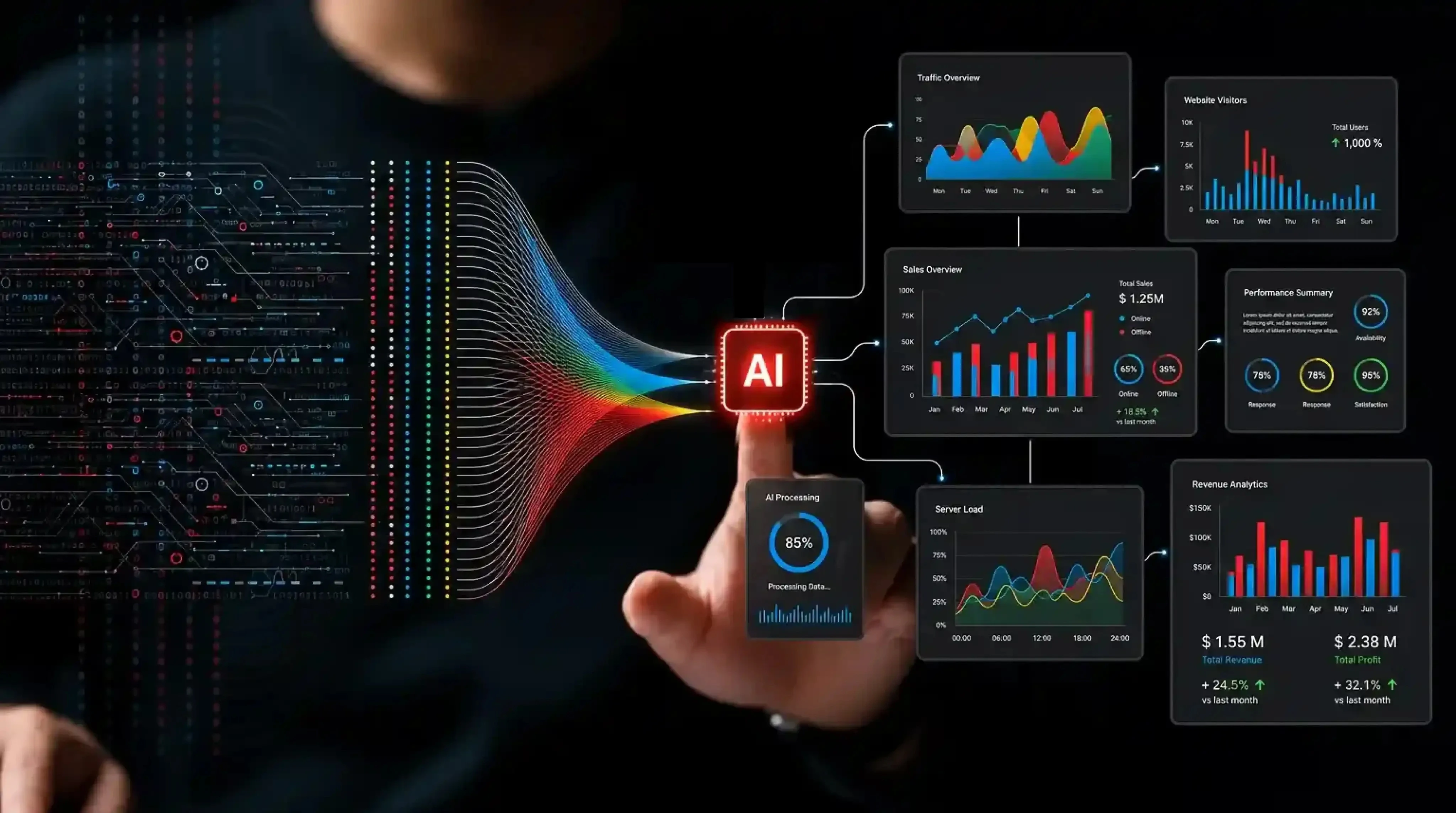
The corporate world is currently moving through the expensive hobby phase of Artificial Intelligence. By 2026, enterprise leaders will have moved past the initial curiosity of what Large Language Models (LLMs) can do and will have collided with the harsh reality of the Implementation Gap. Organizations across the BFSI and Retail sectors have checked the AI-enabled box on their board reports, yet their core unit economics remain stagnant, and their legacy friction persists.
Digital transformation is not a software update; it is a fundamental architectural and cultural pivot. When AI is treated as a layer of digital paint on top of broken, analog processes, it doesn’t transform the business; it simply accelerates failures and incurs much higher compute costs.
To achieve true Digital Transformation, enterprises must move away from these five high-stakes strategic traps that are quietly draining ROI.
1. The Surface-Level Trap: Prioritizing Fancy Features Over Deep Data Connection
The most common mistake in 2026 is launching high-visibility AI features like conversational chatbots or creative marketing tools while the underlying data remains locked in 15-year-old legacy systems.
The Strategic Failure: This is essentially building a sophisticated mouth with no brain. If your AI agent doesn’t have real-time, read-write access to a unified Data Mesh, it cannot perform meaningful actions. In the BFSI sector, this looks like an AI assistant that can talk to a customer about their spending, but cannot actually move money or approve a loan because it can’t access the core banking ledger in real-time. This creates a Hand-off Gap where the user is eventually forced back to a human agent, defeating the purpose of the automation.
The 2026 Pivot: Shift your investment from front-end wrappers to Data Orchestration. Success is defined by Data Fluidity the ability of an AI agent to draw on KYC, transaction history, and risk models simultaneously to make a sound decision.
The Strategy Audit: * Can your AI agent resolve a customer issue without a human hand-off?
Is your data updated in real-time (Event-Driven) or in 24-hour batches?
2. The Engagement Myth: Measuring Clicks Instead of Solving Problems
The most pervasive ROI mistake in digital strategy is sticking to old metrics like Monthly Active Users or Average Time in App.
The Strategic Failure: In a functional enterprise app (banking, logistics, or healthcare), high engagement is often a symptom of process friction rather than brand loyalty. If a user spends 10 minutes in your app to complete a task that should take 30 seconds, your digital transformation has failed. You are effectively paying for AI compute cycles to help a user navigate a maze that your own architecture created. High Time Spent in 2026 is a warning sign of an inefficient experience.
The 2026 Pivot: Pivot your North Star metric to Operational Deflection. The goal of AI-driven transformation should be to kill the task. Measure success by how many support tickets were never opened, how many manual back-office steps were eliminated, and how much the Cost-to-Serve per customer has dropped. True transformation is invisible; it is the friction the user didn’t feel.
The Strategy Audit: * If your app was 50% faster, would your revenue go up or down?
Are you measuring Clicks or Completed Outcomes?
3. The Multi-Brain Problem: Creating Messy Silos Instead of One Intelligence
In a rush to show AI progress, different departments Marketing, HR, and Operations often buy their own separate AI tools.
The Strategic Failure: This creates Fragmented Intelligence. When your Customer Service AI doesn’t talk to your Sales AI, the user experience becomes disjointed. The customer feels like they are dealing with a company with multiple personalities. Furthermore, maintaining five different AI vendors with five different security protocols creates a nightmare of Integration Debt that will eventually require a total (and expensive) rebuild.
The 2026 Pivot: Adopt an Enterprise AI Backbone approach. Use a centralized orchestration layer that allows every department to tap into a shared Intelligence Core. This ensures that every customer touchpoint whether it’s a mobile app, a physical kiosk, or a phone call is informed by the same logic and real-time customer data.
The Strategy Audit: * Does your Marketing AI know when a customer has an open complaint in Service?
How many different sources of truth does your AI currently rely on?
4. The Accountability Gap: Making Decisions Without Explaining the Why.
As enterprises move toward Agentic AI where models actually make financial or operational decisions the lack of Explainable AI becomes a massive legal liability.
The Strategic Failure: When an AI denies a credit line in a BFSI app or flags a healthcare claim as fraudulent without a clear audit trail, the enterprise faces Regulatory Friction. Under modern frameworks like the RBI Master Directions, The algorithm said so is not a valid legal defense. This mistake leads to heavy fines, lawsuits, and a total collapse of customer trust.
The 2026 Pivot: Build Glass-Box Models. Every automated decision must be accompanied by simple logic. The system should not just deliver a Yes/No but also the Why and the How-to-Fix for the user. This transparency isn’t just for compliance; it’s a competitive advantage that builds long-term trust.
The Strategy Audit: Can your team explain a specific AI decision to a regulator within 60 minutes?
Does your app provide a Path-to-Resolution for every automated rejection?
5. The Set and Forget Mistake: Scaling Without Human Supervision
The final, most expensive mistake is the belief that AI is a one-and-done project. Enterprises often assume that once a model is deployed, the work is over.
The Strategic Failure: This ignores Model Drift. As market conditions, global regulations (such as CIMS or FLDG), and user behavior shift, static AI models become less accurate over time. Without a robust Human-in-the-Loop strategy, the AI will eventually start making Confident Mistakes, leading to catastrophic operational errors such as incorrect pricing in Retail or mismanaged risk profiles in Insurance.
The 2026 Pivot: Implement Active Learning Loops. Digital transformation is a continuous feedback cycle, not a destination. Your strategy must include a dedicated Model Observability layer where human experts verify edge cases and teach the AI in real-time. This ensures your intelligence evolves at the same pace as your business.
The Strategy Audit: * How often is your AI model retrained on fresh, real-world data?
What is your Fail-safe protocol when the AI encounters an unusual case?
The Strategic Verdict: Orchestration Over Implementation
Digital transformation in 2026 is no longer a race to buy technology; it’s a race to orchestrate outcomes. The enterprises that win the next decade aren’t those with the largest AI budgets, but those with the most integrated data and the clearest path to Operational Deflection.
When you stop treating AI as a feature and start treating it as the operating system of your business logic, you unlock the true ROI of digital change.
At NeoSOFT, we help global enterprises navigate these five traps by focusing on Strategic AI Orchestration. We ensure your data plumbing is ready, your metrics are outcome-based, and your AI is both explainable and resilient. Don’t just invest in AI transform your business architecture to be worthy of it.
(As per leading research, BFSI is ……include data as a starting point of the blog)
(Talk about NeoSOFT naturally in the blog) – Team kindly don’t copy&paste this
Just step into a well-known BFSI company, and you might come across one of those not-so-visible problems behind its success, those old legacy systems.
These systems have been running for decades. They are dependable, essential to the operation, and deeply ingrained in the business processes.
On the other hand, the downside is that they’re quite inflexible, costly, and problematic when it comes to the level of their performance.
In a situation where customers’ needs change so quickly and the market is moving towards offering services mainly through digital channels, these legacy systems may be the very factors that limit businesses.
Whether to implement a system modernization is already a non-debate; the difficult part is finding a way to do so without interfering with current operations. AI-driven digital transformation provides the solution.
Legacy Systems Dilemma
Legacy systems were created for a time when transactions were much less complicated, data was not as abundant, and the ways of communicating with customers were quite limited. On the other hand, nowadays, BFSI companies have to cope with real-time data, delivering customer service through multiple channels, and dealing with regulatory changes.
Legacy systems are not “bad”. In fact, they do their core job quite well. The real issue is that when they are designed to be flexible and integrated with modern applications is complex. Updating them takes time, and scaling them to meet demands can be expensive, leading to:
Slow product launches
Limited opportunities for innovation
High costs of operations
Broken customer experience
Why Traditional Modernization Falls Short
Many companies have already attempted partial upgrades or surface-level changes to tackle this problem. They either introduce new layers, develop APIs, or transfer small parts to the cloud.
Though these measures will certainly be effective to some extent, in many cases, they don’t address the main problem.
Lack of proper planning leads to scattered efforts in modernization, increases system complexity rather than reducing it, and causes teams to devote more time to integration management rather than innovation.
This is why digital transformation consulting can be very helpful. It enables companies to step away from patchwork modifications and to implement a comprehensive transformation plan aimed at long-term success.
However, having a plan is just half of the work. Artificial intelligence is the solution to the problems.
Why Artificial Intelligence Makes a Great Partner on the Road to Transformation
It is needless to say that AI is far more than technology. In fact, it is a strong, capable assistant that helps maximize the worth of both existing and latest systems.
With the help of AI, companies can become smart simply by using what they already have, rather than radically changing everything. AI can do:
1. Intelligent Automation
AI is capable of automating tasks that repeat over and over and were previously done by hand or by systems with fixed logic. From loan approval to real-time fraud detection, automation shortens the cycle and limits human error.
This feature helps not only to operate more efficiently but also to have the team do more valuable work.
2. Getting the Most Out of Your Data
Old systems often store large volumes of data, but only a small percentage is used. In this case, AI is the best fit to handle the data right away by recognizing trends and providing materials that lead to higher-quality decisions.
In this sense, banks, for instance, can make offers to each customer based on their needs, insurers can make more precise risk predictions, and financial institutions can spot anomalies in a timely manner.
3. Seamless Integration
Among the challenges posed by old systems, integration is the most pressing one. With the help of AI-driven applications, one gets assistance with such tasks, as these tools go beyond mere data mapping and extend into areas like predictive maintenance and adaptive workflows.
This way, old systems get aligned with new digital avenues without causing disruptions.
The Role of Legacy System Modernization
AI does not remove modernization; it enhances it.
Legacy system modernization is the transformation of existing systems to align with current and future business needs. This can involve:
Rehosting (moving to cloud)
Refactoring (improving code)
Replatforming (updating to modern platforms)
Replacing outdated systems and components
Integrating AI helps prioritize areas where it can deliver the most impact. Organizations can implement operations gradually rather than using the “rip and replace” approach.
A Practical Approach to Transformation
For BFSI organizations, the journey toward AI-led transformation need not be overwhelming. A structured approach can make it manageable and effective.
Step 1: Assess the Current Landscape
Understand the systems, pain points, and dependencies, and identify the inefficiencies where AI can add value.
Step 2: Define Clear Objectives
Set goals that reduce processing time, improve customer experience, or lower operational costs.
Step 3: Build a Scalable Architecture
Adopt a cloud-based modular architecture supporting flexibility and integration.
Step 4: Integrate AI Strategically
Focus on impact use cases first. Later, you can start small, test, and scale.
Step 5: Continuously Optimize
Transformation is not a one-time effort; it requires ongoing monitoring and improvement to succeed.
Overcoming Common Challenges
While the benefits are clear, organizations often face challenges during transformation:
Resistance to Change: Teams may be hesitant to move away from familiar systems.
Data Silos: Disconnected data can limit AI effectiveness.
Regulatory Concerns: Compliance requirements must be carefully managed.
Skill Gaps: New technologies require new capabilities.
Addressing these challenges requires strong leadership, clear communication, and the right partners.
The Future of BFSI is Intelligent and Agile
Customers expect faster, smarter, and more personalized services. The BFSI industry is leveraging this by introducing digital technologies to innovate rapidly. Organizations that rely on legacy systems alone are at risk of falling behind. But those that embrace AI-led transformation have an opportunity for new levels of growth.
The goal is not to abandon the past, but to build on it—using AI to transform legacy systems into powerful, future-ready assets.
Conclusion
Legacy systems do not have to be an overwhelming process. With the right strategy, AI, and BFSI integration, organizations can transition into efficiency smoothly. Digital transformation services are critical in guiding businesses through every step in their journey.
NeoSOFT focuses on helping organizations navigate this challenge by implementing digital transformation consulting early in the process. Our expert team also enables BFSI enterprises to modernize legacy systems, integrate AI capabilities, and build scalable digital ecosystems. Get in touch with our team at info@neosofttech.com to understand more about digital transformation services and improve customer experiences by staying competitive in the evolving landscape.
Earlier, every customer was the same – sharing the same message, strategies, and offers. However, today, customers expect more. They want the banks and insurers to understand them by sending relevant offers and messages, providing timely communication, and delivering personalized experiences.
When that does not happen, engagement drops, messages go unread, and opportunities for any connection slip away. If engagement feels low, it is often because the experience feels impersonal.
You Already Have the Answers. They Are in Your Data
Here is the interesting part. Most BFSI organizations already have everything they need.
Customer transactions, browsing behavior, service interactions, preferences, and history. It is all there. But in many cases, this data sits in silos, disconnected and underused.
So the problem is not data scarcity. It is data activation.
Turning Data into Conversations, Not Campaigns
Instead of creating general marketing campaigns, AI enables you to have meaningful one-on-one conversations. It analyses patterns, infers needs, and aligns your responses to the customer’s time. This is the point where AI starts to change the situation.
Imagine this: A customer begins looking at different home loan options. Rather than waiting for the customer to come back, your system shares useful, insightful content, eligibility criteria, or even a customized deal with the customer. In another case, a customer who travels a lot is given insurance suggestions that really fit their lifestyle.
These are examples of marketing done smartly. In fact, it is an upgraded experience for the customer.
Personalization Needs a Strong Backbone
To really personalize at a large scale, you have to have a solid digital base. AI by itself cannot make changes. Your systems should be communicating with one another. Your data must be transferred without interruption. And your infrastructure has to be capable of real-time decision-making.
Without these, even the finest plans fail to provide the expected outcomes.
Making It Work with the Right Partner
NeoSOFT is the right partner that turns scattered data into meaningful action. Our AI and Machine Learning Services help you understand customer behavior and anticipate what comes next. From predicting churn to building recommendation engines, AI becomes practical and measurable.
At the same time, our Data Engineering Services bring your data together. No more silos. Just a clear, unified view that supports better decisions.
And with our Cloud Services, you gain the scalability to deliver these personalized experiences in real time, without delays or disruptions.
What Changes When You Get It Right
When personalization starts working, you see the difference almost immediately.
Customers engage more. They respond better. They stay longer. And they are more open to exploring additional products and services.
But beyond metrics, something more important happens. Trust begins to build. And in BFSI, trust is everything.
Conclusion
Low engagement is not only a lack of communication. It also means that customers are not feeling understood. Luckily, the answer is closer than you think. Data is available. Technology is up to speed.
It is time to combine both to create experiences that are less like marketing and more like engaging conversations. NeoSOFT is equipped to help the BFSI sector personalize with AI-powered products and Machine Learning. Besides that, it ensures data integration runs smoothly with Data Engineering and Cloud Services, helping to establish a scalable project environment.
Frequently Asked Questions (FAQs)
Why is customer engagement low in BFSI?
Customer engagement is low because the communications feel irrelevant and generic. Organizations can choose to personalize interactions for a better service. It can also improve business when customers feel they are understood.
How does AI improve customer personalization?
AI analyzes customer data to identify patterns, preferences, and behaviors. This allows organizations to deliver timely and relevant recommendations, and interactions meaningful and engaging.
Do BFSI organizations already have enough data for personalization?
Yes, BFSI organizations handle large volumes of data, and the challenge is not collecting it but using it effectively to generate insights.
What role does cloud play in personalization?
Cloud processes large amounts of data and scales it. It allows organizations to deliver personalized experiences quickly and efficiently.
In 2026, the digital landscape is filled with costly mobile app ghost towns. They feature LLM integration, predictive analytics, and conversational interfaces, but lack user growth and see double-digit churn. We are now in the AI Adoption Paradox: more AI features lead to more user friction.
For the BFSI and Retail sectors, the stakes are existential. In a High-Speed Scrolling economy, an app has only 1.8 seconds to prove its utility. If your AI is a hurdle, not a lubricant, users won’t just leave. They will migrate to a competitor who knows the best AI is one the user never actually sees.
The following analysis connects the business impact of these failures to a blueprint for high-adoption, Agentic futures, guiding readers seamlessly into seven core feature decisions currently sabotaging digital transformation.
1. The Conversational Everything Fallacy: Forcing Friction into Flow
The industry’s first instinct was to turn every app into a chatbot. We saw banking apps where Check my balance required a three-sentence dialogue with a virtual assistant. This is a fundamental misunderstanding of mobile ergonomics and user psychology.
The Strategic Failure: Mobile users rely on Muscle Memory. They want fast, tactile interactions. Forcing them to shift from tapping to typing or talking for routine tasks bumps up cognitive load by 400%. Replacing a one-tap UI with a chat interface is not innovation. It is a regression to an old command-line era, merely wrapped in a modern LLM.
The 2026 Pivot Agentic UX: Stop asking users to describe their needs. Use Situational Intent Engines to surface the Next-Best-Action as a dynamic UI element. If a user opens a retail app on a Saturday morning, the AI shouldn’t wait for a query; it should preemptively surface the tracking status of their Friday order or a One-Tap Reorder for their weekly staples. The goal is Zero-UI, where the interface adapts to the user’s current State without a single word being exchanged.
2. Predictive Spam and the Death of Consumer Trust
Personalization has become a dirty word because it has been weaponized by poorly tuned predictive models. Retail and Fintech apps are notorious for Retargeting Loops suggesting a high-end suitcase to a user who just purchased that exact suitcase 10 minutes earlier.
The Strategic Failure: Most predictive models lack Transaction Awareness. They spot category interest but miss Outcome Fulfillment. This creates an Uncanny Valley. The app feels stalker-ish and incompetent. In BFSI, this means Investment Tips sent to users with a declined transaction or low balance a tone-deaf action that kills brand empathy.
The 2026 Pivot (Intent-State Mapping): Move from Probabilistic to Deterministic AI. Your model must recognize the user’s State. If they have already converted, the AI must pivot to Post-Purchase Orchestration (e.g., automated warranty registration or loyalty integration) rather than redundant sales pitches. AI should only intervene when it detects a High-Friction Event, such as a stalled E-KYC process or a failed checkout.
3. The Black-Box Approval: Trust Erosion in Regulated Markets
In the rush to achieve Instant Lending and Algorithmic Onboarding, many banks have handed over the keys to automated decisioning engines. While this speeds up the Time-to-Yes, it creates a catastrophic Wall-of-Silence for the No.
The Strategic Failure: In markets governed by RBI Master Directions or GCC banking norms, The AI said no is not a legal or customer-centric defense. A user denied a credit limit increase by a Black-Box model feels alienated. Without recourse or clarity, the app ceases to be a financial partner and becomes a digital gatekeeper. This lack of transparency is the primary driver of app deletion among high-net-worth users.
The 2026 Pivot (Counterfactual Explanations): Every automated denial must be a Teachable Moment. At NeoSOFT, we implement Explainable AI (XAI) frameworks that provide Path-to-Approval insights. Instead of a generic Rejected screen, the app tells the user: Increase your average balance by $2,000 over 60 days to unlock this limit. This turns a rejection into a roadmap, preserving user LTV and maintaining regulatory integrity.
4. Massive Models on Thin Clients: The Latency Tax
There is a misguided trend of piping every minor app interaction through a 175B-parameter cloud-based LLM. The result is a Processing… spinner that kills the user’s Flow State.
The Strategic Failure: Latency is the silent killer of adoption. In a 2026 5G environment, a 200ms delay is perceptible; a 2-second delay is an exit trigger. Cloud-heavy AI also creates a Privacy Tax. Users are increasingly wary of their sensitive financial or health data (especially under NHCX orchestration), leading them to store it on a third-party server.e 2026 Pivot (Edge-First Architecture): Shift to Small Language Models (SLMs) and on-device NPUs (Neural Processing Units). High-frequency tasks like biometric sorting, predictive text, and UI adaptation must happen on the silicon, not in the cloud. Reserve the LLM for complex, non-linear reasoning. This Hybrid AI approach ensures the app is lightning-fast and privacy-compliant.
5. The Gimmick Overhang: Novelty vs. Utility
During the initial AI hype, apps were flooded with AI Avatars or Generative Backgrounds that had nothing to do with the brand’s core value proposition. A logistics app does not need a generative art feature; it needs a route-optimization engine.
The Strategic Failure: Features that don’t solve key pain points dilute the brand’s authority. This Feature Bloat causes Menu Blindness. Users cannot find the main buttons needed to finish a transaction. Gimmicks create technical debt and demand ongoing maintenance and security patches, all for little ROI.
The 2026 Pivot (Friction-Tested Roadmaps): Implement a strict Outcome-to-Effort Ratio. If an AI feature doesn’t reduce the number of taps required to reach a Golden Transaction (the app’s primary goal), it doesn’t belong in the production build. Every AI deployment must be a Utility Trigger, not a marketing stunt.
6. The Dead-End Insight: The Lack of Agentic Hand-off
Most AI features in 2026 are still Observational they tell you something is wrong but don’t fix it. Your spending is 20% higher this month, says the BFSI app, and then… nothing. The user feels anxious and unsupported.
The Strategic Failure: Information without Agency is just Noise. An app that spots a problem but doesn’t offer a resolution, or Bridge, fails its duty as an assistant. This is common in Retail Media. AI might suggest a product, but the Add to Cart function is broken or buried in menus.
The 2026 Pivot (Agentic Workflows): If an AI identifies a budget overage, it should immediately offer a Fix perhaps a suggestion to move funds to a high-yield savings bucket or an automated recurring payment adjustment. The AI must be the Executor, not just the Reporter. We call this Closed-Loop Intelligence, where the insight and the action exist in the same frame.
7. Sync-Lag: The Stale Data Trap
The most advanced AI engine is only as good as its last data refresh. Many apps suffer from Siloed Intelligence, where the AI layer is disconnected from the core transaction engine.
The Strategic Failure: Imagine a retail app’s AI suggesting a Flash Sale on an item that went out of stock 5 minutes ago because the ERP didn’t sync with the AI’s vector database in real time. This Sync-Lag destroys the user’s belief in the app’s intelligence. In BFSI, showing a Low Balance alert when the user just made a deposit via another channel creates a sense of systemic incompetence.
The 2026 Pivot (Event-Driven Data Mesh): Personalization must be Synchronous. By utilizing Regulatory and Transactional Orchestration, the AI layer must ingest live event streams. Whether it’s NHCX for healthcare claims or CIMS for banking, the AI should only speak when it is 100% sure the data is up to date. If you can’t be real-time, be silent.
The Strategic Verdict: From AI-Powered to Intelligently Orchestrated
User adoption in 2026 is won through Invisible AI. The goal is not for the user to marvel at the AI; it is for the user to marvel at how easy the app has become.
When you avoid these seven costly choices, you stop building an AI-Powered App. Instead, you create a Strategic Asset. The proof is in retention metrics. High-adoption apps don’t feel like they run AI they seem to read users’ minds.
At NeoSOFT, we specialize in moving brands past the Experimental AI phase and into Strategic AI Orchestration. By focusing on transaction observability, edge computing, and explainable models, we ensure that your digital transformation doesn’t just look good on a dashboard it performs in the pocket of your customer.
In the next minute, your institution will process thousands of transactions. In that same window, an automated digital threat can bypass a traditional perimeter. If your response depends on a human middleman, the damage is already done before the first alert is read.
Traditional security was built for a world of physical walls and slow-moving paperwork. Today, the shift to Hybrid Cloud has replaced those walls with infinite digital entry points. We are moving from an era of “watching for threats” to a mandatory era of “autonomous prevention.”
The Response Gap: Your Most Dangerous Liability
In the financial sector, the time to detect a breach is often measured in days. However, modern digital attacks move in the blink of an eye. While teams sift through a fog of “alert fatigue,” automated bots can drain digital vaults and compromise data in a heartbeat.
For a modern bank, being “late” is functionally the same as being “defenseless.” Relying on a human analyst to approve a security response creates a bottleneck that hackers love to exploit. By the time a ticket is raised, the ledger has cleared, and the attacker is gone.
From Manual Watching to Autonomous Acting
The solution is not “more security staff”; it is Agentic AI. This technology marks the shift from a system that tells you there is a fire to one that has already extinguished it before you smell the smoke.
Autonomous Cloud Defense uses machine learning to understand exactly what “normal” behavior looks like for your bank. When a deviation occurs—like an unusual API call from a global branch—the AI doesn’t just send an email. It severs the connection instantly. This is security that thinks and acts at the speed of the threat itself.
The Impact of an Autonomous Guardrail
Instant Neutralization: Threats are stopped in the same moment they are identified.
Regulatory Resilience: Automated systems ensure you stay ahead of strict mandates without manual effort.
Resource Optimization: Eliminates the “noise” of false alarms, allowing your top talent to focus on high-level growth strategy.
Unshakeable Trust: Your reputation remains protected because your systems stay online and secure, regardless of the global threat landscape.
Real-World Proof: The Self-Defending Vault
A leading retail bank recently integrated Real-Time AI into its multi-cloud environment. During a sophisticated attack that bypassed traditional firewalls, the AI identified the pattern across thousands of global endpoints. The system blocked the source in a fraction of a second, preventing significant fraud losses in a single afternoon.
Key Takeaways
Speed is the Metric: If your security cannot act instantly, it is not “real-time.”
AI Handles the Tactics: Let technology handle the defense so your leadership can handle the business expansion.
Modern Cloud Demands AI: You cannot protect a modern digital environment with manual workflows from the past.
Conclusion
The window for “wait and see” has closed. For financial leaders, the choice is no longer between security vendors, but between manual vulnerability and autonomous resilience.
Is your bank built to withstand a breach, or has it just been lucky so far? Secure your future with NeoSOFT and redefine your security with the power of Real-Time AI.
As part of the digital product world in 2026, the Standard User Interface has officially become a technical debt. For many years, software has been designed with a philosophy that follows the approach of the “Greatest Common Denominator,” where designers create only one static journey that will satisfy all users. Today, that is the fastest way to drive users away from your product.
When your high-frequency power user in London opens up your app and sees the same prompts as your first-time visitor in Singapore, your product is not simply “simplistic” – it is irrelevant. The death of the monolithic UI and the rise of the Hyper-Personalization Engines is now here.
1. The Death of the “Average User”
The underlying problem in conventional mobile app development is that it is based on the concept of an “Average User” persona. The fact is, there is no Average User. There are only users defined by changing intentions, contexts, and signals.
Pain Point: The conventional approach to segmentation is too broad. Age, Location, and Gender are not effective at understanding Latent Intent, i.e., the underlying motivation for opening an app at 8:00 AM vs. 11:00 PM.
Advanced AI Solution: The only way to overcome this limitation is for enterprises to adopt Vector Embeddings and Graph Neural Networks (GNNs). This allows users to be modeled in a Multi-Dimensional “Interest Space” rather than being forced into conventional categories. This means that if a person is interested in “Vegan Recipes” and also in “Eco-Friendly Packaging,” it is not that he or she is simply a Foodie. The entire interface will be reconfigured to display sustainability metrics and vegan alternatives.
2. From Reactive UX to Predictive “Liquid UIs”
The most significant change in 2026 is the transition from Reactive Personalization (“Because you did X, here is more of X”) to Predictive Orchestration (“We predict you will want Y, so here is Y now”).
The Architecture of a Liquid UI
A “Liquid UI” is a user interface that does not have a static state. It is dynamically constructed through Contextual Bandits, a highly advanced form of Reinforcement Learning (RL).
How it works:
Every element of the user interface, such as buttons, banners, and navigation tabs, is considered an “Arm” of a multi-armed bandit.
The Goal: Maximize the reward, i.e., the Click-through rate, session time, or conversion rate.
The Result:
If the AI detects that a user is in “Discovery Mode,” the user interface maximizes search and recommendation tiles. If the user is in “Transaction Mode,” the user interface minimizes all distracting elements and displays a one-tap checkout button.
By incorporating NeoSOFT’s AI-driven FE, companies can automate this orchestration, ensuring that Time-to-Value (TTV) is minimized to near zero..
3. The Technical Pillars: Edge AI vs. Cloud Latency
One of the key hurdles in implementing real-time personalization has always been the problem of latency. The round trip of data to a central cloud server in order to determine what color button to render is too slow, breaking the “Flow State” of the user.
The Rise of On-Device Inference
The top applications in 2026 are embracing “Zero Latency Personalization” by moving their inference capabilities to the Edge. This is done through frameworks such as TensorFlow Lite, Core ML, and PyTorch Mobile. These personalization models are run directly on the user’s smartphone.
Privacy by Design: In this scenario, personal behavioral data is never transmitted off the user’s device. This is no longer a “desirable feature” but a “mandated compliance” in an increasingly changing world of data sovereignty regulations.
Offline Intelligence: In an environment without 5G connectivity, the application is “intelligent” and can adapt to user behavior offline. Only then is it synced back to the cloud with “learned weights” once a secure connection is re-established.
At NeoSOFT, we are experts in MLOps for Mobile, ensuring these models are “lightweight” yet “effective” in generating significant ROI..
4. Solving the “Cold Start” Problem with Generative AI
The biggest challenge in personalization is the “Cold Start” problem: how do we personalize the experience for a user we know nothing about?
The solution in 2026 is Generative Synthetic Personas, where the initial referral source, device metadata, and first three interactions are analyzed to create a “User Narrative.” This is done using an LLM (Large Language Model) until enough real-world data is available to switch to high-precision Reinforcement Learning models.
5. The Business Case: ROI of Hyper-Personalization
Why should a CTO invest in this level of architectural complexity? In 2026, the value of “thinking” apps over “doing” apps is measured by the total elimination of friction. By removing the manual navigation layer, enterprises achieve three critical business outcomes:
Accelerated Retention: When an app anticipates a user’s needs, it creates a “Switching Cost.” Users are far less likely to churn when their current provider has already automated their routine workflows and personalized their interface.
Seamless Conversion: Intent-based surfacing drives higher cross-sell revenue by eliminating the “search” phase of the buyer journey. If the app predicts the next logical financial product a user needs, the path to purchase becomes a single tap rather than a multi-screen search.
Predictive Support Efficiency: By deploying anticipatory UX such as surfacing a “How-to” guide or a contextual tip before a user hits a known friction point organizations can significantly lower their support ticket volume and improve overall customer satisfaction scores.
Ultimately, companies that fail to evolve beyond basic, static interfaces will be out-competed by AI-native firms that treat the UI as a living, breathing entity. The shift from a “tool” to an “assistant” is no longer a luxury; it is the new baseline for digital survival.
6. The Roadmap: How to Dismantle “One App for All”
The transition to an AI-First approach in the mobile strategy is not an overnight process. It needs to be done in tiers:
Data Harmonization: Break the silos. The data in your mobile application needs to talk to the data in your CRM and your offline POS systems to build a Customer Data Platform.
Modular UI Design: Redesign your user interface with the principles of “Atomic Design” in place. Every element in your user interface needs to be modular enough for the AI to move it, hide it, or highlight it.
A/B Testing vs. Continuous Learning : Transition away from Static A/B Testing that finds the winner for all users and towards Continuous Evaluation that finds the winner for this user.
Conclusion: Personalization is the New UX
The “Ease of Use” era is over. In 2026, the gold standard is Anticipation of Need. The “One App for All” model was built for a static user who no longer exists. Today’s user is dynamic and time-poor; your product must evolve to match that reality.
By leveraging advanced AI frameworks, Edge computing, and predictive modeling, you can transform a mobile app from a mere tool into an indispensable personal companion. This shift doesn’t just improve the interface; it redefines your brand relationship.
NeoSOFT acts as the architect of this evolution. Our digital transformation services go beyond surface-level automation. We specialize in building Agentic Ecosystems and Intent-Based UIs that process complex data in real-time. Whether it’s integrating Large Action Models (LAMs) or deploying secure, on-device intelligence, we provide the technical backbone for “Invisible UX.”
Is your digital product evolving fast enough? Don’t just pave the cow path reimagine the journey. Partner with NeoSOFT to engineer the next generation of AI-driven mobile experiences.
Want to see Hyper-Personalization in action? Explore how NeoSOFT is helping global leaders eliminate digital friction from intent-driven banking journeys to autonomous logistics orchestration. Browse our latest blogs.
Frequently Asked Questions (FAQs)
1. What is the difference between customization and AI personalization?
Customization is user-led, such as in the selection of a “Dark Mode” option. AI Personalization is system-led, such as in an automatic selection of Dark Mode because it recognizes the user is in a low-light environment and has a history of preferring it.
2. Does AI personalization slow down app performance?
If traditional cloud requests are used, yes. However, if Edge AI (On-device inference) is used, then the latency is virtually zero. Sophisticated models are designed to operate in the background without draining battery or CPU resources.
3. Is hyper-personalization compliant with GDPR and CCPA?
Yes, as long as you make use of techniques like Privacy Preserving AI. This is because Edge AI (processing data directly on devices) and Federated Learning (training models on decentralized data) enable personalization without ever actually viewing the personal information.
4. How much data do I need to start using Predictive AI?
You don’t need to have millions of users. With Transfer Learning, we can use pre-trained models and fine-tune them on your specific niche. With a lower number of users, Reinforcement Learning can start to detect “Quick Win” UI improvements in a matter of days.
5. Can “Liquid UIs” be built on Cross-Platform frameworks like Flutter or React Native?
Absolutely. While the underlying AI logic might be implemented with native modules such as TensorFlow Lite for Android/iOS, the “Liquid” frontend itself can be controlled via dynamic component rendering in any modern framework, including Flutter and React Native.
We use cookies on our website to give you the most relevant experience by remembering your preferences and repeat visits. By clicking “Accept All”, you consent to the use of ALL the cookies. However, you may visit "Cookie Settings" to provide a controlled consent.
This website uses cookies to improve your experience while you navigate through the website. Out of these, the cookies that are categorized as necessary are stored on your browser as they are essential for the working of basic functionalities of the website. We also use third-party cookies that help us analyze and understand how you use this website. These cookies will be stored in your browser only with your consent. You also have the option to opt-out of these cookies. But opting out of some of these cookies may affect your browsing experience.
Necessary cookies are absolutely essential for the website to function properly. These cookies ensure basic functionalities and security features of the website, anonymously.
Cookie
Duration
Description
cookielawinfo-checkbox-analytics
11 months
This cookie is set by GDPR Cookie Consent plugin. The cookie is used to store the user consent for the cookies in the category "Analytics".
cookielawinfo-checkbox-functional
11 months
The cookie is set by GDPR cookie consent to record the user consent for the cookies in the category "Functional".
cookielawinfo-checkbox-necessary
11 months
This cookie is set by GDPR Cookie Consent plugin. The cookies is used to store the user consent for the cookies in the category "Necessary".
cookielawinfo-checkbox-others
11 months
This cookie is set by GDPR Cookie Consent plugin. The cookie is used to store the user consent for the cookies in the category "Other.
cookielawinfo-checkbox-performance
11 months
This cookie is set by GDPR Cookie Consent plugin. The cookie is used to store the user consent for the cookies in the category "Performance".
viewed_cookie_policy
11 months
The cookie is set by the GDPR Cookie Consent plugin and is used to store whether or not user has consented to the use of cookies. It does not store any personal data.
Functional cookies help to perform certain functionalities like sharing the content of the website on social media platforms, collect feedbacks, and other third-party features.
Performance cookies are used to understand and analyze the key performance indexes of the website which helps in delivering a better user experience for the visitors.
Analytical cookies are used to understand how visitors interact with the website. These cookies help provide information on metrics the number of visitors, bounce rate, traffic source, etc.
Advertisement cookies are used to provide visitors with relevant ads and marketing campaigns. These cookies track visitors across websites and collect information to provide customized ads.