Enterprises rely heavily on technology to build scalable, agile and highly available businesses. Event-Driven Architecture is emerging as a key cornerstone enabling modern enterprises to operate in real-time, adapt to changes quickly, and make intelligent business decisions.
“Event-driven architecture (EDA) is a design paradigm in which a software component executes in response to receiving one or more event notifications.”– Gartner
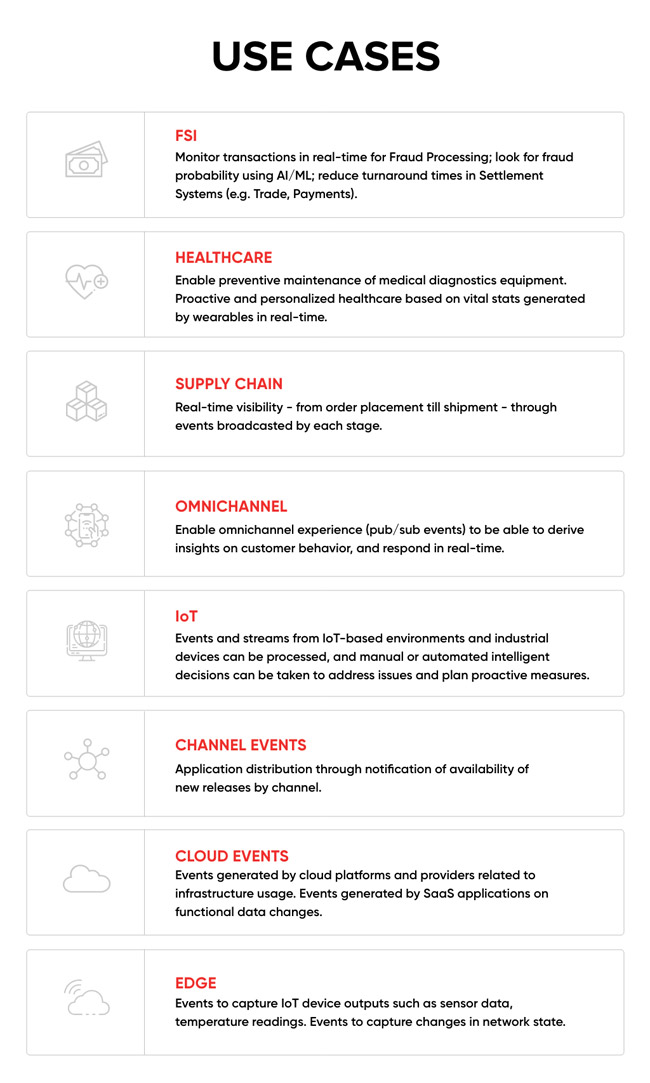
Combining agile methodologies with a platform that can respond rapidly to real-time events empowers businesses to make manual or automated intelligent decisions and achieve true enterprise agility. Events from a variety of sources from Servers to Wearables can then be harnessed to support a number of industrial use cases.
Large organizations that adopt such architectures need to treat Events as first-class citizens of their Platform, along with their APIs and Business Services. Event-Driven Architecture Adoption Patterns
Enterprises that embrace event-driven architecture can capitalize on the benefits of scalable and reliable real-time communication. This can help drive many strategic initiatives across IoT, eCommerce, Data Integration across systems, data and applications, Edge and Financial Fraud Detection, among others.
Companies that add event-driven architecture to their systems and applications can improve the scalability and responsiveness of applications. They can also access the data and context needed for better business decisions, be that stream processing, data integrations or website activity tracking.
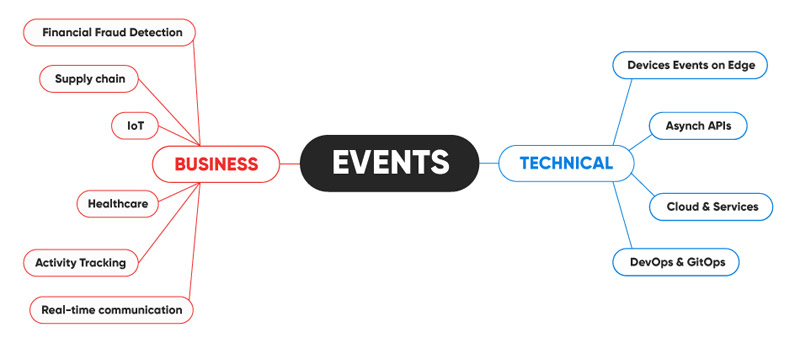
Events are captured as they occur from a spectrum of event sources. On a high-level, these events are categorized into Business/Functional or Technical.
True Stories of EDA Driving Business Value
1. Create a new business model through new channels
Emirates NBD uses Red Hat Fuse and Apache Kafka on Red Hat OpenShift to support real-time banking and partner interactions.
2. Incredible improvement in customer experience
A global Financial Services leader implements a real-time campaign solution that delivered a ~60% increase in campaign conversion rates.
3. Measurable and Effective Operational improvement
A global logistics provider uses an events fabric to provide real-time visibility to shipments across its wide global network.
4. In the field of IoT
A global electronic devices manufacturer used proactive event-based monitoring to reduce the number of service maintenance calls by 45%. Event streaming analytics helped to recognize patterns and prioritize responses to alerts.
5. EDA for Inter-microservices communication
A European bank used an event-driven architecture to improve its relationship with customers. A lightweight event bus-based solution helped keep applications in sync and provided a single view of customer data that enabled in streamlining the customer experience.
Crowdsourcing allows you to tap into the collective intelligence of the crowd to improve innovation performance or discover new ideas.
According to a McKinsey survey, 6% of executives are satisfied with their firms’ innovation performance. When it comes to organizational capabilities, lack of skill, talent, and the ability to execute ideas is mentioned frequently as a barrier to innovation. Without the right skills and capabilities, it’s difficult to achieve the desired results. This may be the primary reason why more companies are embracing the crowd.
Organizations leveraging crowdsourcing are some of the world’s most progressive and innovative like NASA, Lockheed Martin, Mozilla, XPrize, and SAP.
Power of Crowdsourcing
Seeking a better way to feed his troops, Napoleon launched a contest that changed the way people eat to this day. Napoleon used crowd-sourcing in 1795 to improve upon the prevailing food preservation methods of the time. Not surprisingly, the purpose was to better feed his army “when an invaded country was not able or inclined to sell or provide food”. Confectioner Nicolas François Appert claimed the prize worth 12000 francs.
Crowdsourcing has emerged as a recent trend in India and various organizations have been employing it for a social, economic, and environmental impact. Recently, Kerala police launched a crowdsourcing campaign for infusing digital technologies for better policing. They will not only get access to diversity and richness of various ideas that exist in the minds of the citizens but also make citizens proud that they are contributing to the nation.
Recently, AB InBev India launched a campaign to build a sustainable supply chain. They crowdsourced solutions to help connect thousands of farmers to technologies and skills, ensure water access and quality in high-stress communities, partner with suppliers to increase recycling content, and add renewable electricity capacity to regional grids.
With such campaigns, the organizations can focus on their core and at the same time capitalize on external crowds to drive innovation in non-core areas.
Framing of Challenges
Framing of challenges is the key to effective crowd-sourcing. The largest problem is that change-makers spend a very little time in framing the challenges. Most challenges do not get solved because nobody frames them.
Examples of two challenges that will be good to frame-
How to build a sustainable and scalable model to help people in rural areas increase their incomes through rural tourism?
Such a challenge, if opened to the crowd, will invite multiple ideas and can lead to the creation of social enterprises and micro-entrepreneurs.
What could be the alternate use for the FasTag that is affixed to your cars?
By now, one would agree that thousands and thousands of such challenges can be framed and be brought to the crowds to seek solutions and monetary awards can be offered for the most innovative and scalable solutions.
Possibilities from Crowdsourcing
The organizations can aim at getting responses in multiple ways from the crowd. Here are a few examples –
1. Getting a situation analysis done: Research on why India is not self-reliant in Aluminium production is an example of a situation analysis. Such research would help in finding the root causes and each root cause could be framed as a challenge for further ideation and solution-finding.
2. Asking people for ideas: How to help farmers increase their income is an example where if you ask 500 people and you get 500 ideas and some ideas could be great to dig deeper.
3. Building new operational models: Some years ago, ITC solved a challenge on how to eliminate the middlemen from the procurement process of farm produces, and as a result they came up with e-Choupals. This can be said as inventing a new operational model.
4. Getting product designs and prototypes: How touchless dispensers could look like for better health and hygiene?
An organization could seek these answers from the crowd.
From inspiration to action, India has a big leap to take. Along with inspirational campaigns such as ‘Atmanirbhar Bharat’ if combined with effective framing of challenges and engaging with crowds through digital means in getting solutions could act as a catalyst and accelerate the development process.
People often confuse coding and programming and use these two terms interchangeably. Let’s just get this out of the way now — they’re not the same thing, and in fact, they are quite different.
“Coding” and “Programming” are the two most important approaches in Software Development Industries. Coding is basically the process of creating codes from one language to another one. It can also be called as a subset of programming since it actually implements the initial steps of programming.
Programming involves not only coding but also other tasks, such as analyzing and implementing algorithms, understanding data structures, solving problems, and more. Programmers are typically technically-minded and have strong analytical skills.
Let’s try to understand the further differences between the two-
1. Difference Between A Coder And A Programmer
There are plenty of coding lessons and tutorials all over the web that allow learners to master basic coding terminology and learn to write simple apps or websites. On the other hand, programmers need a specialized degree and years of experience to obtain the skills and knowledge that are required to write complex programs.
2. Both Have A Different Scope
When coding, you transform the requirements in a human language into a language that your computer will understand. When programming, you give an app or a machine a set of instructions to be carried out. A programmer is typically responsible for an entire software product whereas a coder is responsible for a certain part or parts of the software product.
3. To Be A Programmer, You Have To Create More
Coders typically follow given instructions and requirements to write code, whereas programmers often use their own imagination and analytical skills to solve specific problems. To be a coder, one should know the syntax, but to be a programmer, one should understand complex data structures and algorithms as well as be able to create such algorithms.
4. Programming Involves Higher-Level Thinking
Another difference between programming and coding is that programming involves a lot of complex thinking. Programmers should be able to come up with abstract solutions to a problem before they even start coding. Besides, they should think proactively and be able to predict as many potential issues as possible. Finally, programmers use code to express their thoughts on how to solve a problem.
Programmers often write or ask technical writers to provide technical specifications – documents containing requirements that the final product should meet and problems that it should solve. Coders then follow those specifications to write code, but do not work on specifications themselves. Programmers are also involved in compiling, debugging, testing, and implementation of the code. In other words, the duties of a programmer can go far beyond coding.
5. Programming Is Creating A Book, Coding Is Writing A Chapter
To find the difference in the programming vs coding discussion, we can compare a programming language to a human language such as English. Such comparison shows that a programmer is a person who knows English perfectly and can produce a lengthy work in English. On the other hand, a coder is a person who knows English at a basic level and can write a short story in English.
As organizations adapt to the ongoing COVID-19 crisis, their agile teams can be a real source of competitive advantage. Such teams are typically well suited to periods of disruption, given their ability to adapt to fast-changing business priorities, disruptive technology, and digitization.
Here’s how to ensure they’re effective now that COVID-19 has forced them to work remotely.
1. Sustaining the people and culture of a remote agile team
Remote work for agile teams requires a considerable shift in work culture. It takes a more purposeful effort to create a unified one-team experience, encourage bonding among existing team members, or onboard new ones, or even to track and develop the very spontaneous ideas and innovation that makes agile so powerful, to begin with.
2. Revisit the norms and ground rules for interaction
Virtual whiteboards, instant chat, and videoconferencing tools can be a boon to collaborative exercises and usually promote participation. But they can also require teams to reconsider existing norms and agreed-upon ground rules. Some challenges may require team members to adjust to the tools themselves: team members should be generous with one another in offering practical support on navigating virtual tools—such as help formatting or recording presentations or informing the host about any technology issues. Teams need to get up to speed quickly on visual management and virtual whiteboarding and tailor established ceremonies into standard virtual routines. New ground rules for communication may be needed to keep people who are interacting virtually from talking over one another. Importantly, teams need to be respectful of personal choices. Working from home blurs the lines.
3. Cultivate bonding and morale
Many of the kinds of activities that nurture morale for co-located agile teams—such as casual lunches, impromptu coffee breaks, or after-work social activities—are not possible in a virtual environment. Team members should encourage one another to introduce their pets and family members and to show any meaningful items in their working space. Working remotely, teams need to make a more conscious effort to be social, polite, precise, and tactful—to ensure everyone feels just as safe contributing remotely as they did in person. Agile teams working remotely may also require a more deliberative focus on empathy, openness, respect, and courage.
4. Adapt coaching and development
With coaching, agile teams should aspire to model remotely everything they would have done in person—but more frequently, given the abruptness of the switch to remote format. If you would do one-on-one coaching over coffee, try doing it remotely—while actually having coffee over video. Encourage all team members to turn on their video and actively monitor body language during group meetings, especially those in the role of a coach.
5. Recalibrating remote agile processes
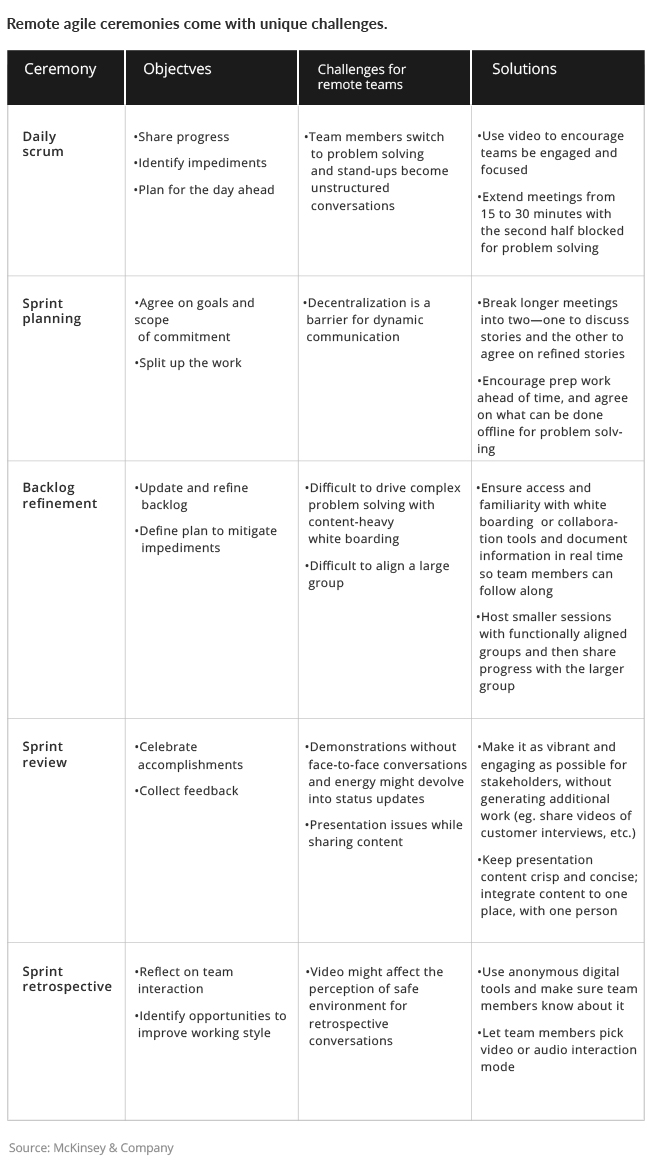
The challenge for remote agile teams is that they’ll be tempted to try to replicate exactly whatever has worked for them in a co-located setting. But what worked in the office setting won’t always work remotely. The trick is to work backwards—start with the outcomes you were getting in the office and modify your scrum ceremonies as appropriate.
6. Establish a single source of truth
Working remotely, teams may need to consider a different approach to documenting team discussion—producing a so-called single source of truth to memorialize agreements. This can then be kept in a single shared workspace. A remote stand-up can be more involved than an in-person one, depending on a team’s cohesiveness and it’s maturity. If team members don’t all participate in the event—or if there’s a risk that they’ll be distracted during the call—then it’s important to calibrate the process to the context. The right approach is likely to be team specific, depending on team maturity and existing norms. Others might find it sufficient to simply submit their notes to a shared online workspace, with a bot to collect and compile everything for the records.
7. Adjust to asynchronous collaboration
Asynchronous communication, such as messaging boards and chat, can be an effective means to coordinate agile teams working remotely. In fact, we have already seen some teams replacing certain traditional ceremonies with asynchronous communication. For example, a team in a services institution has replaced some of the daily huddles by a dedicated messaging channel to which team members submit their updates and identify impediments to further work. This has the benefit of allowing team members to raise red flags at any point during the day, and it serves as the registry of concerns that have been raised and addressed. Note that asynchronous communication needs to be used carefully. Teams that grow overly reliant on asynchronous channels may see team members feeling isolated, and the trust among them may suffer.
8. Keep teams engaged during long ceremonies
A remote-working arrangement creates new challenges in keeping agile teams motivated and avoiding burnout. Working in isolation is hard for any person, but particularly for agile teams accustomed to face-to-face communication and frequent interpersonal engagement. Multitasking and home-based distractions also take a toll, depending on how things are set up. At one US financial institution, for example, a scrum master realized that staring at a video screen for more than a couple of hours was draining without the dynamic interaction of an in-person workshop. Her solution? For longer meetings, she began to schedule in a ten- to 15-minute exercise break every 90 minutes—with a shared videoconference tool to recommend different exercises.
9. Adapting leadership approach
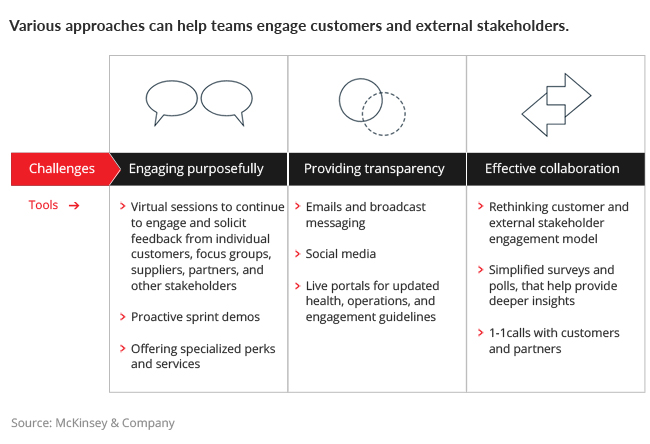
The core mission of leadership stays the same, whether co-located or remote. But leaders need to be more deliberate when engaging with customers and teams, especially when you have limited in-person interaction. Leaders in this context can be anyone on the team, whether product owners, scrum masters, or even a developer demonstrating leadership. They also need to be purposeful at engaging external customers and stakeholders. They must be transparent and reassuring in their communication about team performance and objectives. The tools and approaches can vary. But the individuals and interactions should be the main consideration. Leaders need to show, in their tone and approach, that everyone is in this together.
The abrupt shift to a remote-working environment was a dramatic change that particularly affected agile teams. The hope is that these changes won’t be permanent. But for now, teams can reinforce productivity by taking a purposeful approach to sustaining an agile culture and by recalibrating processes to support agile objectives while working remotely.
The COVID-19 crisis has changed the way we lived some time back. Education which was channelized through schools/institutions in different formats, has now got a new look. Virtual classrooms, online exams, online forums, activities, etc. are no longer introduced by few. And soon, it will be a new normal for every education organization moving forward.
EdTech is the now the buzz and Artificial Intelligence (AI) is making significant inroads in the education industry. What has helped the most is the fact that the younger generation is quick to embrace new technologies. Integrated with Facebook, Twitter, Skype, and other social media apps, the Conversational AI in the form of educational chatbots can engage students and provide short but valuable information.
What is Conversational AI?
Conversational AI, as a subset of Artificial Intelligence (AI), can enable the user and the machine to interact in the user’s spoken or written natural language, just as he/she would, when interacting with a human. It places the responsibility on the technology interface to learn what the user wants and to adapt accordingly, rather than the user having to learn the technology, saving time, and enhancing the user experience.
Ease of Learning
The most useful and sought-after application of AI is the automated, intelligent tutoring system that provides a personalized learning environment to study in and then analyses the students’ responses and their patterns of interaction with the learning content.
AI chatbots can interact with students in these environments, either through a series of standard text messages or multimedia such as images, videos, audios, and document files, which would make them feel like it is a regular classroom.
Lectures can be broken down into interactive conversation flows with the help of engagement tools and impressive UI so students can learn anywhere and at any time.
The chatbot can continuously assess each student’s level of understanding and provide them the next part of the lecture as per their progress.
After learning the topic, the bot can present the students with adaptive assessments. The results gathered from these assessments can be visualized in interactive dashboards to better understand how the students are learning different subjects and topics.
Enhanced Student Engagement
Students prefer texting to any other form of communication. They are active across all instant messaging platforms and social media. Whether they want to communicate with each other, research topics, or find help with their assignments, they reach out through these platforms.
This gives us the opportunity to enhance the students’ learning process and increase engagement by integrating AI chatbots on social media platforms such as Facebook, Twitter, and others.
These apps can then act as a medium for student-teacher communication, just like in the classroom, lab, or activity clubs.
This will make it easier for the students to get information on their assignments, due dates, and other important upcoming events.
Safe and Secure Feedback
A very important and significant aspect of the learning process is feedback, whether it comes from a student and is directed towards the teachers or the other way around. Feedback helps students in identifying the topics that require extra attention, as well as, helps teachers figure out areas that they can improve their teaching abilities in.
Conversational chatbots can conduct surveys such as feedback on how the courses could be improved, how did the students like their previous lecture, or the overall quality of their learning experience.
Similarly, the teachers can provide feedback on the tests or assignments submitted by the students.
The bot can collect all the feedback and analyze it to highlight the most common points mentioned, giving the teachers the opportunity to identify gaps in their teaching efforts and do better.
The teachers’ feedback allows the students to identify the areas where they need to do some extra work. This not only leads to a deeper learning experience but also helps them understand lessons and course concepts better.
AI-Based Teaching Assistants
Students often put ‘do my assignment’ requests over the internet to find an assistant who can help them in completing their assignment or to get a clearer explanation of a specific topic that they are struggling with. Similarly, teachers also want help in simplifying their everyday tasks.
Conversational bots can act as virtual teaching assistants to take the burden off and help teachers focus more on providing quality education to their students.
The bots can answer the students’ queries about the course module, lesson plans, lecture schedules, assignments, and deadlines.
They can monitor the learning progress of the students, provide personalized feedback, and recommend more relevant learning content by analyzing their learning skills and capabilities.
24/7 Student Assistance
This generation is so used to getting everything instantly — whether it is sending an email, making a purchase, or posting a picture — it likes it done in as few clicks as possible. The educational institutions must also speed up their student communication process to draw the attention of this fast-paced generation.
With millions of prospective students enrolling in colleges and universities across the world, the number of queries each institution receives over its website is massive. These are mostly repetitive, such as queries regarding the admission process, courses, scholarships, fees, etc.
Chatbots can easily step in and save all the time that it would take to manually reply to these queries. This would not only save a great deal of time for the students but would also diminish the burden of the institutions.
“The most promising opportunity to use this technology is to support a much more personalized approach to on-campus services that still appeals to a large crowd. The system will also help lower the burden on stressed-out faculty, as they no longer have to explain the same things over and over to different students.”
Better Support for Students
It is imperative that every institution guides its students thoroughly by giving them timely and accurate information. But it is nearly impossible to make sure each student is being taken care of fully without any technological intervention.
An AI chatbot can help students get updates on almost anything — admission processes, assignment deadlines, upcoming events, course modules, and more.
The chatbots can further help new students find out more about scholarships, hostel facilities, library memberships, and so on.
In Conclusion
In the unprecedented times that we all currently find ourselves in, virtual learning is set to become an essential part of every educational institution. Conversational AI will not only benefit the overall teacher-student interaction and improve the classroom environment, but will also enhance the learning experience for the students.
Today’s teams are different from the teams of the past: They’re far more diverse, dispersed, digital, and dynamic (4-D). But while teams face new hurdles, their success still hinges on a core set of fundamentals for group collaboration.
The basics of team effectiveness were identified by J. Richard Hackman – a pioneer in the field of organizational behavior who studied that personalities, attitudes, or behavioral styles of team members do not deter collaboration. Moving further, the modern teams require a 4th critical condition to eliminate the “us versus them” thinking. He came up with ‘4 Enabling Conditions’ that help teams to achieve high performance-
1. Compelling Direction
Having a direction energizes, orients, and engages team members, giving their team a solid foundation. A team will not feel inspired if the members don’t know what their common goal is.
These goals need to challenge them – modest goals do not motivate. But, they should not be so challenging that they discourage team-morale. These goals should also be consequential. People care about goals if they gain something from it – like incentives, promotion, and recognition, or even satisfaction and a sense of meaning. Having a direction acts to unite team members irrespective of their values and backgrounds, especially at the global level.
2. Strong Structure
Teams perform well when they have the right mixture of members who have a balanced set of skills among themselves. Not every person can be technically superior and highly social. Diversity in age, gender, and race help bring diversity in knowledge, views, and perspectives, which pushes teams to be more creative and avoid groupthink. Increasing members is a good way to ensure diversity, but it also leads to increased costs and also poor communication. The aim should be to have the minimum number – no less and no more.
Tasks assigned should be designed carefully. Not everything has to be creative, some tasks do require dull, hard work. But these tasks can be made motivating by allocating significant responsibility to the team and providing them with performance feedback.
One thing to watch out for are destructive dynamics. Everyone has seen team members withhold information, force people to conform, avoid responsibility, cast blame, etc. These can be minimized by establishing clear rules. They can be a small list of things that should ALWAYS BE DONE (like being on time or letting others speak) and that should NEVER BE DONE (like interrupting others). Norms make it easier to bridge gaps between nationalities, regionalities, and cultures.
3. Supportive Context
Right support enables effectiveness. It includes maintaining a reward system that recognizes performance, an information system that gives access to data, an educational system that facilitates training, and also resources those secure materials required for doing the job, like funds and technical assistance. Although not everyone gets everything, trying to secure these is a good start. Ensuring supportive context becomes necessary among geographically distributed teams. Because what might seem like a cultural clash can easily be a result of differences in resources.
4. Shared Mindset
Despite being a team, members don’t perceive themselves as a single group, but as a sub-group. While this is human nature, it also leads to every group viewing themselves as slightly favorable and superior to others – a habit that gives rise to tension and hinders collaboration. A good solution is to develop a common mindset by fostering a common identity and understanding.
Another issue is that of incomplete information. Experts in certain fields tend to have more information than those who are not, and this information is not useful if it is not shared or if these members are new or are dispersed across the globe or both. Shared knowledge spikes collaboration. A different reason for incomplete information is digital communication impeding information exchange. It could occur due to language differences or simply because digital communication is not as effective at transmitting non-verbal cues, which are an important aid in face-to-face meetings.
Whatever the reason be, fortunately, there are ways that leaders can foster a shared identity and understanding, and eradicate all that hinders cooperation and information exchange. A good way is to ensure that everyone feels valued for their contributions toward the team’s overall goals.
Evaluating your team
The enabling conditions make for a good recipe to build an effective from scratch. But, they can also be used on existing teams by focusing on the four fundamentals. To check if your efforts are working, there are three criteria: output, collaborative ability, and members’ individual development. They are a good way to calibrate the team. Have regular, superficial monitoring to rate your team in each of the four conditions as well as the three criteria. The weak areas will be where you need to focus on and might even help you understand where the problems are rooted. Next, also have less frequent, deeper checks if/when problems emerge, like poor performance or some crisis. You can increase the impact of your intervention by holding a full-scale workshop for all the members to discuss and compare results together. Comparing assessments give you complete data as well as reveals differences in viewpoints, which leads to deeper insights.
Teamwork is tough and complex in today’s times. As teams constantly go virtual, global and project-driven, handling these teams become equally tricky. In such a scenario, having a systematic approach to analyze your team set-up and identify areas of improvement can take you a very long way.
Consider this case: You have to travel to another country for a business meeting. You’ll surf through various websites and then choose the one that offers the lowest prices on hotel and ticket booking. Next, you’re surrounded by a feeling of victory. ‘Oh yeah, I’ve saved a lot!’ You’ll share the news across with your social circle in ecstasy. Then, you come to know that your colleague landed with the same deal, but at prices lower than that of yours. That’s price discrimination which is caused by dynamic pricing.
What is price discrimination? Why does it take place? How can you get the best prices for a product/service? We’ll answer all these questions in the post. So, settle down and read!
By its literal definition, dynamic pricing is an approach by which businesses sell the same product at variable prices to different customers.
But how does it happen?
Let’s find out!
Well, we all use the internet to buy various products, for online booking and to leverage various services. Generally, when we browse the web, our information like location, device, browser and demographics is left behind in the cloud. This data is then used by companies to set the ‘ideal’ price or the price that we can afford for a particular product/service. The companies use various factors to find our financial power and then set the ideal price.
Now, let’s understand it better how dynamic pricing takes place.
1. Price discrimination based on location
Many companies track the geographic locations of users and exploit machine learning algorithms to set the ideal price. For example, users placing an order from developed countries like the US will have to pay a higher price than those users from developing or under-developed countries.
2. Price based on devices
Users can place an order from multiple devices like the laptop, mobile phone, tablet, etc. Hence, many companies use the ‘device type’ as a metric to set price. For example, users that make a purchase via iPhone will be charged more than the users with android phones.
3. Price based on time of purchase
Arrays of companies follow the practice of charging users based on the time they’ll make a purchase. For example, prices for commodities are higher during festivities while the prices may be lowered when the commodities are reaching their expiry period.
4. Segmented pricing
Many times, companies gauge the ‘willingness of buyers to pay more for the specified product/service’ to set the ideal price. For example, a product with a warranty may be charged higher. Similarly, the customers that expect faster service will be charged higher prices than others.
5. Peak user pricing
This is one of the most common strategies of dynamic pricing. Under this strategy, users have to pay higher prices for the same product/service at peak hours. For example, airlines and other transportation companies will charge higher during rush hours i.e. weekdays while the charges might be lower at weekends.
These were some strategies that companies exploit to exercise dynamic pricing. However, as a user, we all have to suffer. Just because we earn an iPhone and live in a developed country, doesn’t mean we will be happy to pay more. Everyone like savings.
So, what’s the solution? How can you land with the best deal and avoid dynamic pricing?
This is where PricingBlocker steps in. It is a robust browser extension that will enable you to get better prices for products/services. It does so by blocking your information so that it is not shared on the web. Furthermore, it also optimizes the information that you’ll share on the web. In a nutshell, the extension allows you to shop anonymously. In this way, companies won’t be able to track your financial power and you’ll be charged with normal pricing for the product/service.
Some of the key features of this tool are:
It blocks ads
The extension blocks Geo location tracking
It facilitates Incognito mode
It offers proxy anonymization
The extension helps in switching browser, browser language
It offers Operating System Switcher
It offers the timestamp optimization
The extension works on most of the websites including Airbnb, Air Asia, Amazon, Ali Express and Agonda.
As you can see this extension works wonders. All you have to do is download the extension from chrome store, install it and let it unfold its magic!
Vulnerability Assessment and Penetration Testing (VAPT) is a security testing method which identifies the security bugs in a software program, a computer network, a server or a system infrastructure. Since both tests serve a different purpose, they are often misunderstood as 2 different test. Albeit, the goals of both the tests are different, they serve a complementary purpose and in order to get the most out of it, they should be applied together for optimum results.
What is Vulnerability Assessment (VA)?
Vulnerability Assessment is the first stage in security testing where the objective is to find bugs in the entire software or the network. It is a rapid automated review of network devices, servers, and systems to identify key vulnerabilities and configuration issues that an attacker may be able to take advantage off.
In a nutshell, the vulnerability test answers the question – “What are the issues on my network?”
The incomplete side of this test is that it cannot differentiate between exploitable and non-exploitable vulnerabilities. And this is exactly where the second stage, Penetration Testing (PT) gets in.
What is Penetration Testing (PT)?
Penetration Testing is an in-depth expert-driven activity focused on identifying the exploitable vulnerabilities identified during VA. Penetration tests find exploitable flaws and measures the severity of each. Penetration test actually spots the possible routes through which an attacker can get through a network. Not stopping there, it will move further and also gauge the potential damage it can do once it gets a breakthrough.
Penetration Testing answers the question “What an attacker can do?”
VAPT – The Whole Picture!
Together, VAPT helps organizations get a more cohesive and detailed picture of their current security vulnerabilities, how exploitable they are, and how largely could it impact. When it comes to having flawless security, VAPT offers excessive benefits to the organizations.
Benefits of VAPT
Provides the organization a detailed view of potential threats faced in a network or an application.
Helps organization in identify the programming errors that could possibly lead to cyber-attacks.
Provides intensive risk management system
Safeguards the business from loss of reputation, money, and access to Intellectual properties
Secures properties from internal and external attacks
Protects the organization’s data from malicious attacks
Why is VAPT important?
Gaining deep insights in the smallest aspect of the software development life cycle (SDLC) is very crucial. Being aware of the vulnerabilities that exist, the weak elements get more apparent during the SDLC. No matter how talented the development team in your organization could be, the possibilities of bugs cannot be denied. Even the smallest ignorance can prove to be detrimental to your organization’s security posture as a whole.
NeoSOFT Technologies has a strong team of VAPT Testers and we provide you with a thorough VAPT report and regular VAPT audits and testing. With us, you can rest assured be that your organization’s data and IP is in safe hands.
While Startups is the ongoing buzz today, the thrust of tech Startups has been predominantly noticed across the world. The credit could be given to the substantial fodder and fostering environment that the youths receive today at their academia. The seed to launch the next successful Startup is sown here, which gets eager to grow to a sapling!
Well, it is not as rosy as it seems to be and many would agree that raising a Startup is no less than a roller-coaster ride. Fixing upon an unambiguous idea, creating a sustainable vision, approach funding sources (remember, not every Startup can afford to be bootstrap), and working in budget-limits and optimum resources can prove to be a tough juggling job. Simultaneously, financial planning has a crucial role to play in the early stages of the Startup, especially when the cost of human capital and infrastructure keeps growing.
To every problem is a solution, and that’s exactly where ‘Outsourcing’ answers the common woes of the Startups. Much has been spoken about the pros and the cons of outsourcing, but at the onset, this decade-long successful mantra has been beneficial and gained wide popularity. And, today, India happens to be the most widely chosen outsourcing partner and has become a hotbed for offshore software development with an irresistible proposition to offer.
Let’s see how outsourcing addresses the top 3 worries of a Tech Startup-
Channelizing the seed-fund effectively: After getting seed-funded through venture capitalists, the ROI timer begins immediately and you are periodically probed for maximum returns within a stipulated time. Here, outsourcing comes to rescue which promises committed deliverables and assures ROI on the money that you invest in outsourcing. Eventually, when each penny of yours begin yielding revenue, the investors also start finding value in your business model.
Operational Cost-cutting: Capital expenditure is one of the biggest chunks to manage and you may find hard to minimize this overhead. Setting up an infrastructure, investing in the latest software’s, resources hiring cost, training and retaining them can give a major financial setback to your business. Outsourcing to NeoSOFT Technologies eliminates this problem and with its flexible engagement model, your operational cost gets reduced to almost 300%.
Save Time, Energy and Money: The IT environment is highly dynamic and you may never realize the demand for scaling-up or having resources with specialized skills. The need could be contractual or fixed but may change over a period of time. Team augmentation services of NeoSOFT Technologies addresses this and gets you moving by providing dedicated resource(s) who are adroit at the latest technologies and frameworks. Do what you are best at, and outsource the rest! That’s how you can focus on your core business functionalities.
The benefits of outsourcing are wide, but to each one is its own. Hence, cost-cutting cannot be the only criteria while opting for outsourcing. It is important for a business model to analyse individual goals and check what suits them before running to the mill.
NeoSOFT Technologies has been a trusted IT Outsourcing partner for businesses worldwide since 22+ years. We are a leading company to offer flexible engagement options and firmly believe in delivering bespoke solutions so that you get the most after associating with us. Feel free to reach us at info@neosofttech.com and we shall be happy to help you build a promising Start-up of the year!
With almost all professions moving to the internet to promote their products, it is not surprising that the profit margins of companies that are in these professions are also increasing. Companies now hire developers and programmers that help them analyze the market trends, changes in effect, and help them create products that the customers want. Technology has only been getting better and more accessible and using the latest technologies can help make businesses more productive and profitable. It is not a hidden fact that software developers have been playing a major role in this lately and it has only gotten bigger.
Salesforce Developers have been becoming more and more popular each year. Salesforce is a major technology firm that provides software solutions to several other companies in order to improve their business. A Salesforce Developer is a part of this and the job of a Salesforce Developer can really help better the position of a business. These developers write code on the basis of what the business wants and require. In that way, the needs as well as the benefits of the business are portrayed to the customers in a simultaneous way. This is done through mobile applications, desktop websites, and mobile websites, among others. A Salesforce Developer uses several programming languages and concepts, but Visualforce and Apex are two of the most important terms in this respect. Visualforce is about the interface, while Apex is about custom logics. Also with regard to programming, a developer should be aware about Object Oriented Programming methods like inheritance, data binding, and polymorphism.
Using all these techniques, a Salesforce Developer can really help make a business better. Understanding the needs and requirements and bringing them out in the products of the company through software skills requires a lot of concentration and patience and that is exactly what a Salesforce Developer requires. We here at NeoSoft Tech look to hire top Salesforce Developers so that they can help our clients with their businesses. We are fully committed to helping our clients build on their businesses and we are certain the help they get from these developers will be pivotal.
We use cookies on our website to give you the most relevant experience by remembering your preferences and repeat visits. By clicking “Accept All”, you consent to the use of ALL the cookies. However, you may visit "Cookie Settings" to provide a controlled consent.
This website uses cookies to improve your experience while you navigate through the website. Out of these, the cookies that are categorized as necessary are stored on your browser as they are essential for the working of basic functionalities of the website. We also use third-party cookies that help us analyze and understand how you use this website. These cookies will be stored in your browser only with your consent. You also have the option to opt-out of these cookies. But opting out of some of these cookies may affect your browsing experience.
Necessary cookies are absolutely essential for the website to function properly. These cookies ensure basic functionalities and security features of the website, anonymously.
Cookie
Duration
Description
cookielawinfo-checkbox-analytics
11 months
This cookie is set by GDPR Cookie Consent plugin. The cookie is used to store the user consent for the cookies in the category "Analytics".
cookielawinfo-checkbox-functional
11 months
The cookie is set by GDPR cookie consent to record the user consent for the cookies in the category "Functional".
cookielawinfo-checkbox-necessary
11 months
This cookie is set by GDPR Cookie Consent plugin. The cookies is used to store the user consent for the cookies in the category "Necessary".
cookielawinfo-checkbox-others
11 months
This cookie is set by GDPR Cookie Consent plugin. The cookie is used to store the user consent for the cookies in the category "Other.
cookielawinfo-checkbox-performance
11 months
This cookie is set by GDPR Cookie Consent plugin. The cookie is used to store the user consent for the cookies in the category "Performance".
viewed_cookie_policy
11 months
The cookie is set by the GDPR Cookie Consent plugin and is used to store whether or not user has consented to the use of cookies. It does not store any personal data.
Functional cookies help to perform certain functionalities like sharing the content of the website on social media platforms, collect feedbacks, and other third-party features.
Performance cookies are used to understand and analyze the key performance indexes of the website which helps in delivering a better user experience for the visitors.
Analytical cookies are used to understand how visitors interact with the website. These cookies help provide information on metrics the number of visitors, bounce rate, traffic source, etc.
Advertisement cookies are used to provide visitors with relevant ads and marketing campaigns. These cookies track visitors across websites and collect information to provide customized ads.